


San Rafael vs Irvine — Commercial Glass Installation Demand vs Executive Growth
Two Affluent California Markets. Two Different Growth Stories.
Commercial glass demand often follows economic growth.
New businesses require space.
Property owners pursue modernization.
Developers respond to changing market conditions.
San Rafael and Irvine both benefit from strong commercial fundamentals, yet each market creates opportunity through different mechanisms.
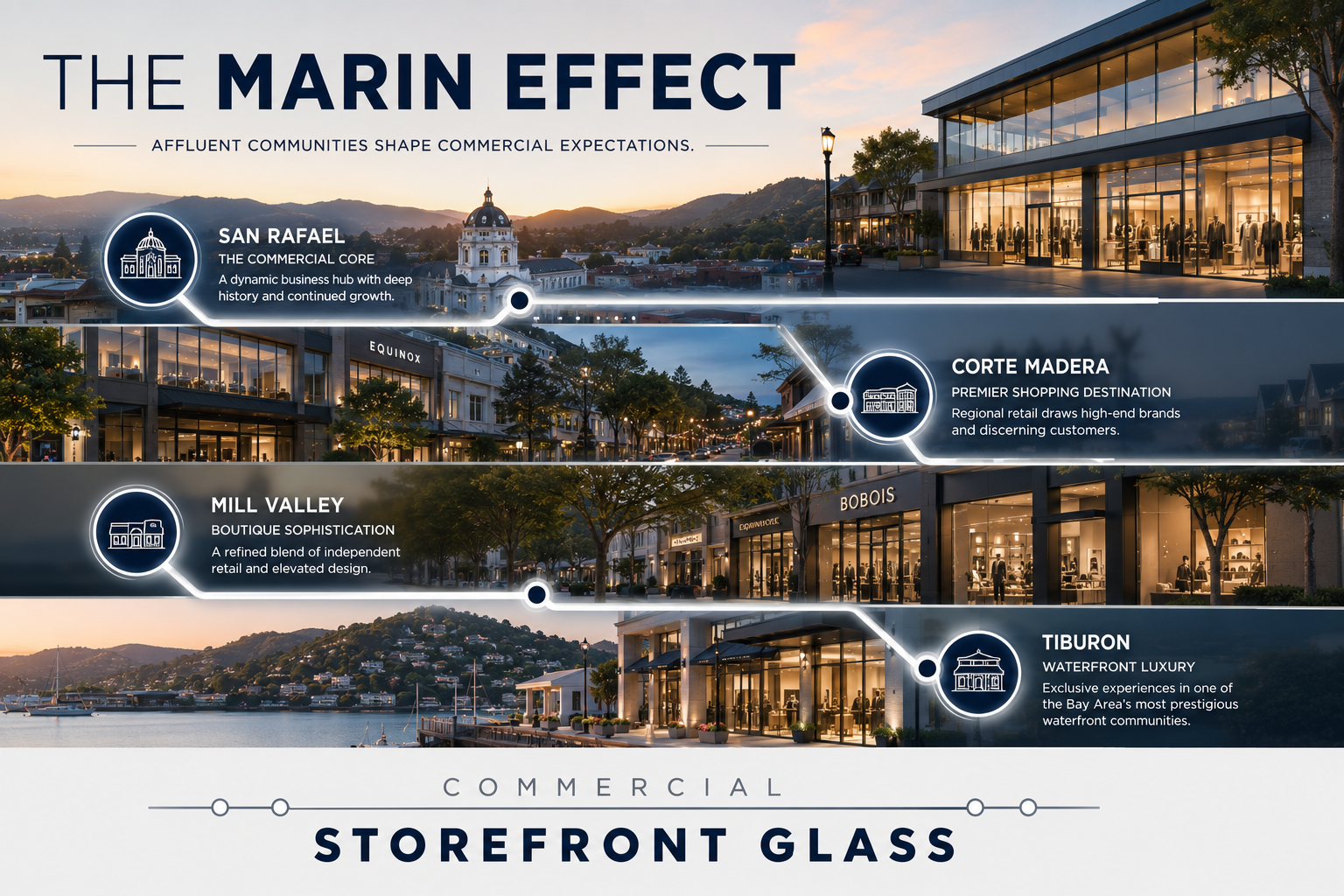
Marin County’s commercial center continues generating demand through property improvements and redevelopment.
Irvine remains one of California’s premier corporate and executive business environments.
Those distinctions influence where and why commercial glass projects occur.

Market Snapshot
San Rafael
- Marin County’s primary commercial hub
- Established retail districts
- Medical and professional office presence
- Mixed-use redevelopment activity
- Customer-focused commercial properties
Irvine
- Major Southern California business center
- Large concentration of corporate headquarters
- Executive office campuses
- Technology and professional services growth
- High-value commercial real estate inventory
Both markets support commercial glazing activity.
The drivers behind that activity often look very different.
Why Commercial Glass Installation Demand Remains Strong In San Rafael
Many projects in San Rafael originate from existing properties.
Building owners continue investing in modernization.
Retail districts benefit from storefront upgrades.
Mixed-use developments frequently incorporate new glazing systems.
Medical offices remain active renovation candidates.
Common installation projects include:
- New storefront systems
- Commercial entrances
- Tenant improvement glass
- Facade upgrades
- Property repositioning projects
Visibility remains important throughout many commercial districts.
Exterior presentation often supports leasing, customer attraction, and long-term property value.
Why Executive Growth Supports Investment In Irvine
Irvine has developed into one of California’s most significant executive business markets.
Corporate campuses continue attracting investment.
Professional service firms occupy substantial office inventory.
Technology companies contribute additional growth.
Executive-oriented environments often prioritize:
Focus Area | Typical Objective |
Workplace Quality | Attract top talent |
Building Performance | Improve efficiency |
Corporate Image | Strengthen brand perception |
Tenant Attraction | Increase competitiveness |
Modernization | Support long-term value |
Commercial glass frequently becomes part of larger investment strategies designed to maintain premium workplace environments.
Installation Activity vs Executive Expansion
The distinction between these markets becomes clearer when examining where demand originates.
San Rafael
Commercial glass demand often comes from:
- Storefront modernization
- Downtown reinvestment
- Retail improvements
- Mixed-use redevelopment
- Existing building upgrades
Irvine
Commercial glass demand frequently comes from:
- Executive office growth
- Corporate campus investment
- Workplace modernization
- Office repositioning
- Professional services expansion
Both generate commercial glass projects.
The economic drivers simply differ.
Modern Commercial Properties Continue Evolving
Tenant expectations continue changing across California.
Natural light remains important.
Energy performance influences ownership decisions.
Building image affects leasing activity.
As a result, commercial glass systems often support broader goals such as:
- Workplace experience
- Customer experience
- Sustainability initiatives
- Property modernization
- Long-term competitiveness
Those trends remain visible throughout both markets.
Which Market Creates More Commercial Glass Opportunity?
Irvine likely generates greater overall commercial glass demand.
Executive growth continues supporting commercial real estate investment.
Large office inventories require ongoing modernization.
Corporate campuses regularly pursue workplace improvements.
Professional service firms and technology companies contribute additional renovation activity.
San Rafael remains highly active.
Retail properties continue replacing aging storefront systems.
Mixed-use projects create installation opportunities.
Medical offices regularly pursue modernization initiatives.
However, Irvine’s scale, concentration of executive office space, and corporate investment environment likely produce a larger volume of commercial glass projects overall.
San Rafael often creates demand through property upgrades.
Irvine frequently creates demand through business growth and executive-driven commercial expansion.
Key Market Differences
Category | San Rafael | Irvine |
Primary Driver | Property Modernization | Executive Growth |
Common Project Type | Storefront Installation | Office Modernization |
Property Focus | Retail, Medical, Mixed-Use | Corporate, Office, Technology |
Demand Source | Existing Buildings | Business Expansion |
Upgrade Objective | Visibility & Reinvestment | Workplace Quality & Competitiveness |
Long-Term Trend | Commercial Revitalization | Executive Commercial Growth |
Commercial glass remains an important part of both markets.
San Rafael demonstrates how modernization sustains demand within established commercial districts.
Irvine illustrates how executive growth and corporate investment continue creating opportunity across Southern California’s most influential business environment.