


Storefront vs Curtain Wall
Commercial buildings throughout the Bay Area rely on glazing systems that balance architectural design, structural performance, and long-term building efficiency.
Should a project utilize a traditional storefront system?
Or is a curtain wall the better long-term solution?
Whether developing office towers inSan Francisco, technology campuses inSan Jose, biotechnology facilities inSouth San Francisco, corporate headquarters inRedwood City, or mixed-use developments inOakland, selecting the right glazing system influences building performance, customer experience, energy efficiency, and long-term property value.
Storefront systems define the street-level experience.
Curtain walls shape modern skylines.
Both play an essential role in commercial construction throughout the Bay Area.
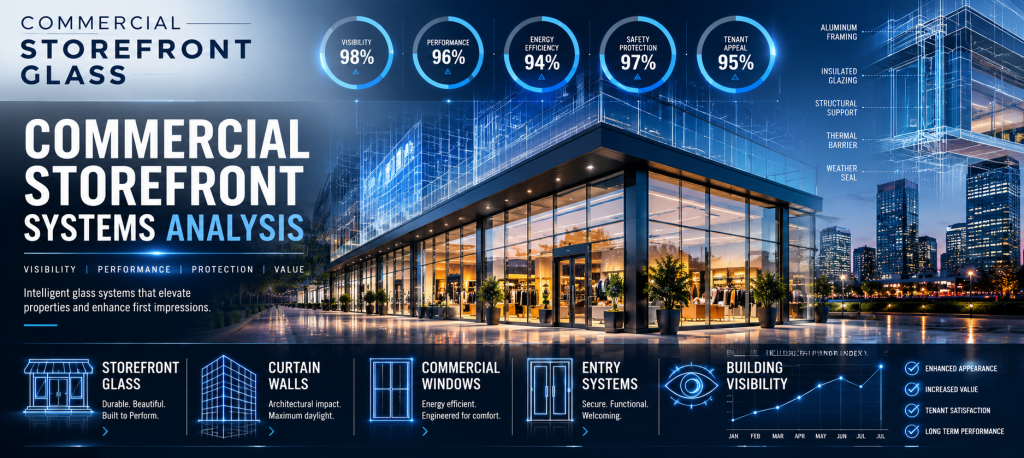
Storefront systems create functional customer-facing environments
Curtain walls support high-performance commercial architecture
Both strengthen long-term building performance
Building design ultimately determines the best solution
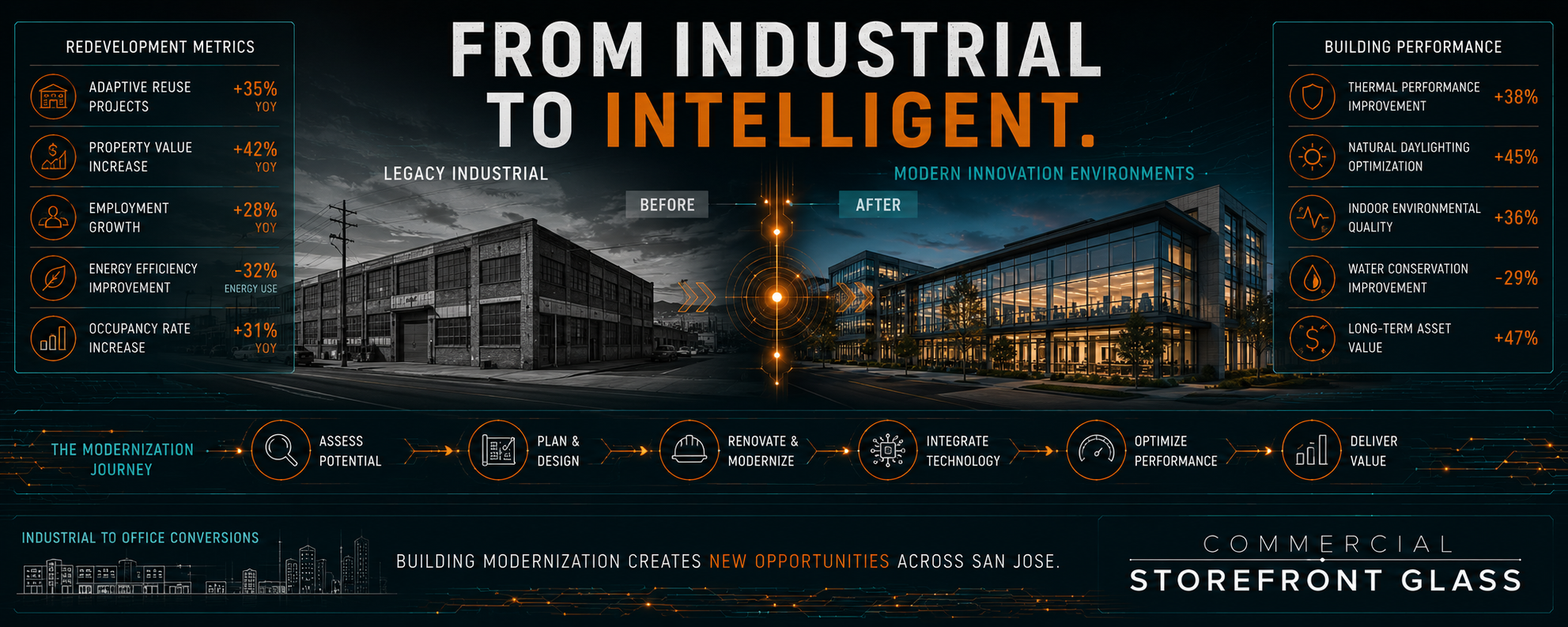
How Commercial Glazing Systems Have Evolved
Commercial building design has changed dramatically over the past several decades.
50 Years Ago
Most commercial buildings relied on traditional storefront systems and conventional window assemblies.
Many buildings throughout San Francisco, Oakland, Berkeley, San Jose, and older downtown business districts utilized:
- Aluminum storefront framing
- Single-pane glazing
- Basic commercial entrances
- Limited thermal performance
Curtain wall systems were generally reserved for larger office towers, hotels, and institutional buildings.
25 Years Ago
Commercial redevelopment accelerated throughout the Bay Area.
Corporate campuses expanded.
Downtown skylines evolved.
Building owners increasingly focused on:
Larger glass facades
Better energy performance
Modern architectural design
Reduced maintenance costs
Curtain walls became increasingly common on larger commercial developments, while storefront systems continued evolving with improved thermal performance and architectural flexibility.
10 Years Ago
Commercial real estate became increasingly performance driven.
Ownership groups prioritized:
Sustainability
Workplace quality
Daylighting
Building envelope performance
Today, storefront systems and curtain walls frequently complement one another within the same commercial development.
Commercial Properties Utilizing Storefront And Curtain Wall Systems
Nearly every commercial development incorporates one or both glazing systems.
Project activity remains common across:
- Downtown San Francisco office towers
- San Jose corporate campuses
- Fremont advanced manufacturing facilities
- Santa Clara technology parks
- Mountain View and Sunnyvale research campuses
- Palo Alto life science properties
- Redwood City and South San Francisco biotechnology facilities
- Walnut Creek and Pleasanton office centers
- Oakland mixed-use redevelopment
- Santa Rosa healthcare campuses
- Napa hospitality properties
- Fairfield logistics facilities
Different commercial environments create different priorities.
Retail centers emphasize storefront systems.
High-rise office buildings depend on curtain walls.
Corporate campuses frequently incorporate both.
Healthcare facilities prioritize long-term building performance.

Storefront Systems
Storefront systems are designed primarily for ground-level commercial applications.
They provide entrances, display windows, and customer-facing architecture while supporting accessibility and security.
Typical storefront applications include:
- Retail centers
- Restaurants
- Medical offices
- Professional office buildings
- Hospitality properties
- Mixed-use developments
Common advantages include:
Excellent customer visibility
Flexible entrance design
Cost-effective construction
Easier maintenance
Storefront systems remain especially common throughout Walnut Creek, Pleasanton, Dublin, Livermore, Berkeley, Concord, and neighborhood commercial districts across the Bay Area.
Curtain Wall Systems
Curtain walls are non-load-bearing exterior facade systems that attach directly to a building’s structural frame.
They are commonly used where expansive glazing, structural performance, and architectural impact are priorities.
Typical curtain wall applications include:
- Office towers
- Corporate headquarters
- Healthcare campuses
- Research laboratories
- Hotels
- Institutional buildings
Common advantages include:
Expansive daylighting
Modern architectural appearance
High-performance glazing
Superior building envelope integration
Throughout commercial markets like San Francisco, San Jose, Redwood City, Palo Alto, and South San Francisco, curtain wall systems remain a defining feature of modern commercial architecture.
At a Glance: Storefront vs Curtain Wall
| Storefront System | Curtain Wall | |
|---|---|---|
| Typical height | Ground floor and low-rise openings, usually one to two stories | Multi-story facades spanning floor to floor |
| How it is supported | Sits inside the opening, supported at the head and sill | Hangs from the floor slabs on anchors; carries no building load |
| Construction | Stick-built on site from aluminum frame members | Stick-built on site or unitized (factory-assembled panels) |
| Wind and water | Suited to lower wind loads; drains through sill flashing and weeps | Engineered for higher wind loads with pressure-equalized drainage |
| Typical frame depth | About 4.5 to 6 inches | About 6 to 10+ inches |
| Relative cost | Lower per square foot | Higher per square foot; project-engineered |
| Common uses | Retail fronts, entrances, office lobbies | Office towers, hospitals, mid- and high-rise buildings |
Building Envelope Performance
Both storefront systems and curtain walls contribute to overall building performance.
Each serves a different purpose.
Storefront systems create durable customer-facing entrances.
Curtain walls protect larger commercial structures while maximizing daylight and energy performance.
Modern ownership groups frequently evaluate:
Thermal performance
Water management
Air infiltration
Structural movement
Long-term durability
Across technology campuses in Santa Clara County, office developments in San Mateo County, and mixed-use projects throughout Alameda County, glazing system selection increasingly supports broader building envelope objectives.
Commercial Markets Driving Storefront And Curtain Wall Construction
Commercial glazing investment continues throughout nearly every major Bay Area market.
Ongoing activity remains common across:
- San Francisco
- San Jose
- Oakland
- Fremont
- Santa Clara
- Sunnyvale
- Mountain View
- Palo Alto
- Redwood City
- South San Francisco
- San Mateo
- Burlingame
- Foster City
- Menlo Park
- Walnut Creek
- Pleasanton
- Dublin
- Livermore
- Concord
- Berkeley
Many commercial developments combine storefront systems at street level with curtain walls above, creating integrated building envelopes that improve aesthetics, performance, and tenant experience.
Regional Commercial Drivers
Three Bay Area counties consistently generate the highest concentration of commercial glazing projects.
Santa Clara County
As the economic center of Silicon Valley, Santa Clara County contains one of the nation’s largest concentrations of corporate headquarters, semiconductor manufacturing, research laboratories, and technology campuses.
Commercial investment remains especially active throughout San Jose, Santa Clara, Sunnyvale, Mountain View, Cupertino, Milpitas, Campbell, Los Gatos, Morgan Hill, and Palo Alto.
Common priorities include:
Corporate campus construction
Research facility expansion
High-performance building envelopes
Workplace modernization
San Mateo County
San Mateo County connects San Francisco with Silicon Valley while supporting one of the nation’s highest concentrations of biotechnology, healthcare, hospitality, and corporate headquarters.
Commercial investment remains active throughout Redwood City, San Mateo, South San Francisco, Burlingame, Foster City, Menlo Park, San Carlos, Belmont, and Millbrae.
Common priorities include:
Corporate headquarters
Laboratory development
Curtain wall modernization
Building envelope performance
Alameda County
Alameda County combines technology, logistics, manufacturing, healthcare, higher education, and mixed-use redevelopment into one of California’s most diverse commercial markets.
Major commercial activity extends across Oakland, Fremont, Berkeley, Pleasanton, Livermore, Dublin, San Leandro, Newark, Alameda, and Hayward.
Common priorities include:
Mixed-use redevelopment
Storefront modernization
Industrial office improvements
Long-term building performance
Which System Fits The Building?
Every commercial project presents different architectural and operational goals.
Storefront systems perform exceptionally well at ground level where visibility, accessibility, and customer interaction matter most.
Curtain walls excel on larger buildings where expansive glazing and high-performance building envelopes become priorities.
Many of the Bay Area’s most successful commercial developments incorporate both systems into one cohesive design.
Across San Francisco, San Jose, Fremont, Redwood City, South San Francisco, Walnut Creek, Oakland, Pleasanton, Santa Rosa, Napa, and commercial markets throughout the Bay Area, storefront systems and curtain walls continue defining the next generation of commercial architecture.
That evolution makes storefront versus curtain wall one of the most important discussions in commercial glazing, connecting directly to architectural design, building envelope performance, tenant improvements, sustainability, energy efficiency, and long-term commercial property value.


