


Emergency Board-Up vs Commercial Glass Repair
Commercial property emergencies rarely happen on a convenient schedule.
A vehicle impact.
Storm damage.
Vandalism.
Burglary.
Broken storefront glass can immediately expose a building to additional damage and security risks.
Should the property be secured with emergency board-up services?
Or should commercial glass repair begin immediately?
Whether managing retail centers in Oakland, office buildings in San Francisco, technology campuses in San Jose, shopping centers in Walnut Creek, or industrial properties in Fremont, protecting the building quickly often becomes the highest priority.
Emergency board-up provides immediate security.
Commercial glass repair restores long-term building performance.
Both services play a critical role in protecting commercial properties throughout the Bay Area.
✓ Emergency board-up secures damaged buildings
✓ Commercial glass repair restores normal operations
✓ Both reduce long-term property risk
✓ Project conditions ultimately determine the best response
How Emergency Commercial Glass Services Have Evolved
Commercial property protection has changed significantly over the past several decades.
50 Years Ago
Emergency response often focused on temporary protection until replacement glass became available.
Many buildings throughout San Francisco, Oakland, Berkeley, San Jose, Richmond, and older downtown business districts utilized:
- Single-pane storefront glass
- Basic aluminum storefront systems
- Limited security glazing
- Conventional entrance systems
Board-up services primarily prevented unauthorized entry while waiting for repairs.
25 Years Ago
Commercial redevelopment accelerated.
Retail centers expanded.
Office buildings modernized.
Property owners increasingly focused on:
✓ Faster emergency response
✓ Better security
✓ Reduced downtime
✓ Improved building appearance
Commercial glass repair became more integrated with emergency response planning.
10 Years Ago
Commercial real estate became increasingly performance driven.
Ownership groups prioritized:
✓ Business continuity
✓ Tenant safety
✓ Property security
✓ Building envelope performance
Today, emergency board-up and commercial glass repair frequently work together as part of the same recovery strategy.
Commercial Properties Frequently Requiring Emergency Response
Nearly every commercial property may eventually require emergency board-up or commercial glass repair.
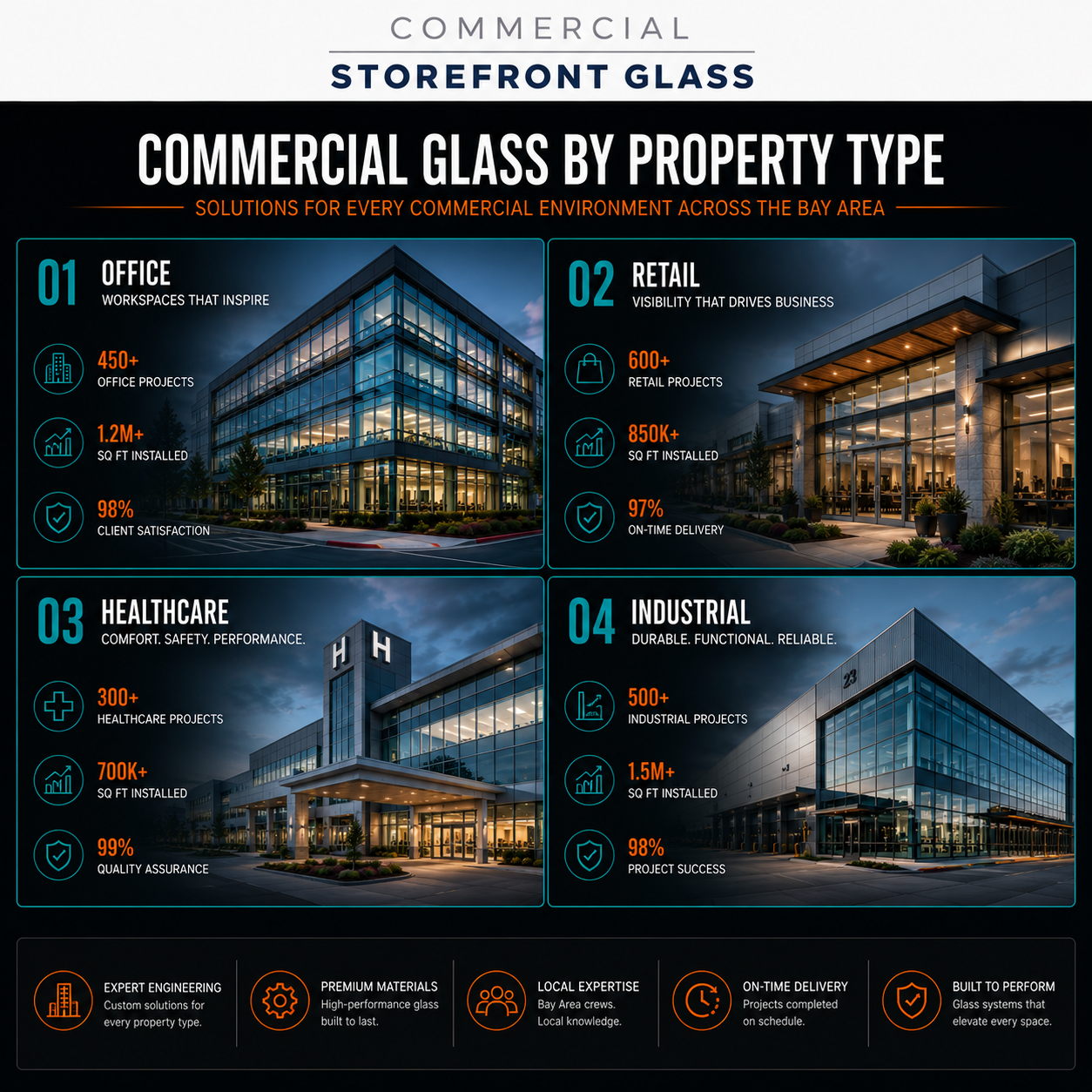
Project activity remains common across:
- Downtown San Francisco office towers
- Oakland retail corridors
- San Jose corporate campuses
- Fremont advanced manufacturing facilities
- Santa Clara technology parks
- Mountain View and Sunnyvale research campuses
- Redwood City and South San Francisco biotechnology facilities
- Walnut Creek and Pleasanton shopping centers
- Santa Rosa healthcare campuses
- Napa hospitality properties
- Fairfield logistics facilities
Different commercial environments create different priorities.
Retail properties often require immediate security.
Office buildings prioritize business continuity.
Industrial facilities focus on operational safety.
Healthcare environments protect patients and staff.
Emergency Board-Up
Emergency board-up services provide immediate temporary protection after commercial glass has been damaged.
The objective is to secure the property until permanent repairs can be completed.
Typical situations include:
- Vehicle impacts
- Vandalism
- Burglary
- Storm damage
- Broken storefront glass
- Unsafe building conditions
Common advantages include:
✓ Immediate security
✓ Weather protection
✓ Reduced liability
✓ Protection from additional damage
Throughout commercial districts like Oakland, Richmond, Berkeley, Concord, San Francisco, and San Mateo, emergency board-up services help stabilize damaged properties while replacement materials are ordered.
Commercial Glass Repair
Commercial glass repair restores the building after the immediate emergency has been addressed.
Repair projects commonly include:
- Storefront glass replacement
- Door glass replacement
- Commercial window repair
- Insulated glass replacement
- Aluminum framing repairs
- Hardware replacement
Common advantages include:
✓ Permanent restoration
✓ Improved building appearance
✓ Restored security
✓ Long-term building performance
Commercial glass repair remains especially active throughout growing markets such as Fremont, Dublin, Livermore, San Jose, Redwood City, Walnut Creek, and South San Francisco, where commercial properties require rapid recovery with minimal business interruption.
Building Envelope Performance
Emergency board-up protects the building immediately.
Commercial glass repair restores the integrity of the building envelope.
Modern ownership groups frequently evaluate:
✓ Structural security
✓ Water intrusion prevention
✓ Air infiltration
✓ Thermal performance
✓ Long-term durability
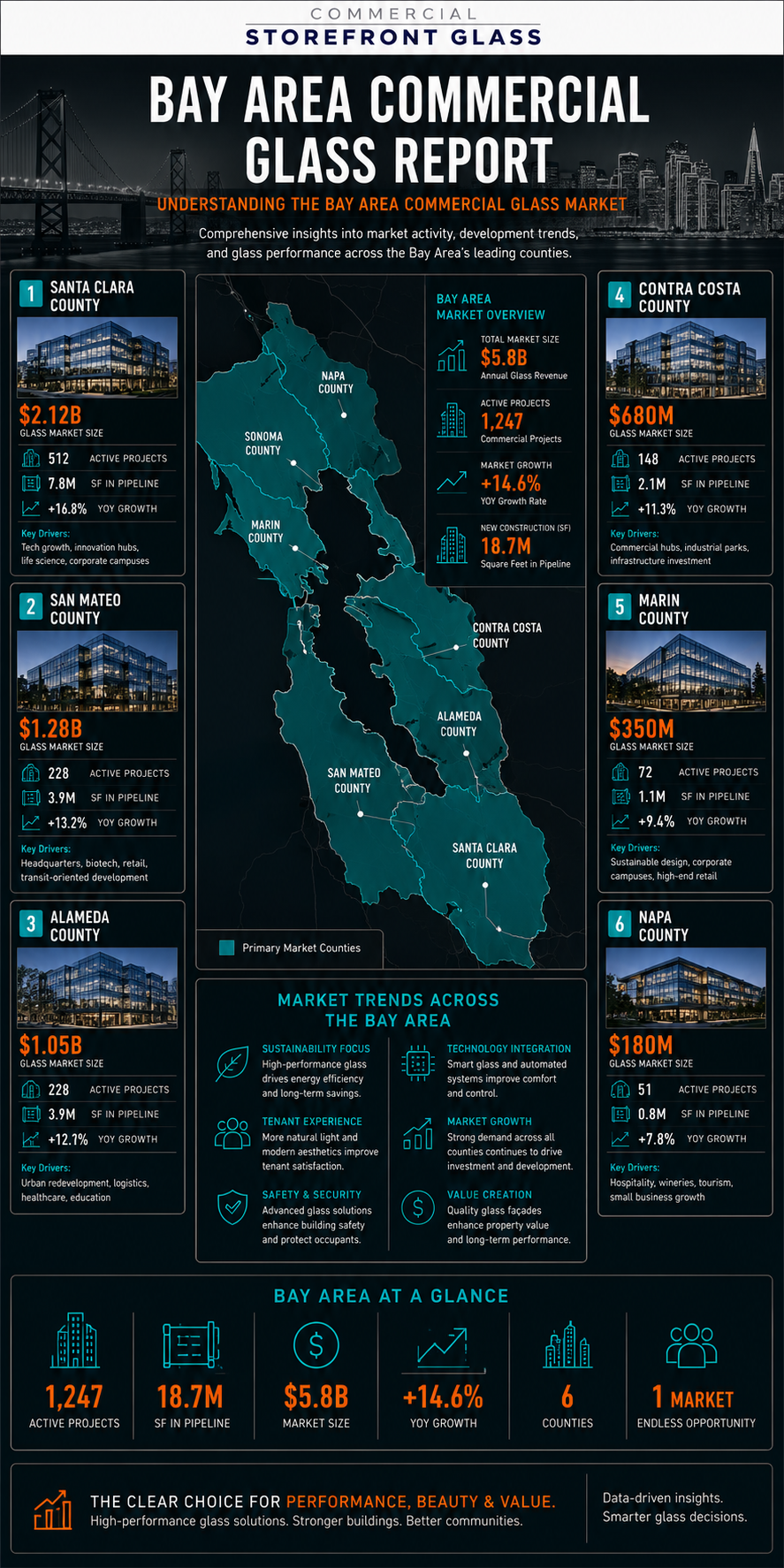
Across technology campuses in Santa Clara County, office developments in San Mateo County, and mixed-use properties throughout Alameda County, emergency response increasingly transitions quickly into complete building envelope restoration.
Commercial Markets Driving Emergency Response
Emergency commercial glazing work continues throughout nearly every major Bay Area market.
Ongoing response remains common across:
- San Francisco
- Oakland
- San Jose
- Fremont
- Santa Clara
- Sunnyvale
- Mountain View
- Palo Alto
- Redwood City
- South San Francisco
- San Mateo
- Walnut Creek
- Pleasanton
- Dublin
- Livermore
- Concord
- Berkeley
- Richmond
High-traffic commercial corridors, aging storefront systems, severe weather, construction activity, and accidental impacts all contribute to ongoing demand for emergency services and permanent commercial glass repair.
Regional Commercial Drivers
Three Bay Area counties consistently generate the highest concentration of emergency commercial glazing projects.
Alameda County
Alameda County combines dense urban corridors, manufacturing facilities, logistics centers, retail districts, and mixed-use redevelopment into one of California’s busiest commercial markets.
Major commercial activity extends across Oakland, Fremont, Berkeley, Pleasanton, Livermore, Dublin, San Leandro, Newark, Alameda, Hayward, and surrounding business districts.
Common priorities include:
✓ Emergency property security
✓ Storefront restoration
✓ Retail recovery
✓ Mixed-use redevelopment
Santa Clara County
As the economic center of Silicon Valley, Santa Clara County contains one of the nation’s largest concentrations of corporate headquarters, research laboratories, advanced manufacturing, and technology campuses.
Commercial investment remains especially active throughout San Jose, Santa Clara, Sunnyvale, Mountain View, Cupertino, Milpitas, Campbell, Los Gatos, Morgan Hill, and Palo Alto.
Common priorities include:
✓ Business continuity
✓ Corporate campus protection
✓ Rapid glass replacement
✓ Workplace safety
San Mateo County
San Mateo County connects San Francisco with Silicon Valley while supporting one of the nation’s highest concentrations of biotechnology, healthcare, hospitality, and corporate headquarters.
Commercial investment remains active throughout Redwood City, San Mateo, South San Francisco, Burlingame, Foster City, Menlo Park, San Carlos, Belmont, and Millbrae.
Common priorities include:
✓ Facility security
✓ Laboratory protection
✓ Hospitality recovery
✓ Building envelope restoration
Secure The Property First, Restore It Second
Every commercial emergency requires immediate decisions.
Emergency board-up protects the building from additional damage.
Commercial glass repair restores normal operations and long-term building performance.
The best response depends on the extent of the damage, occupant safety, building security, material availability, and overall property conditions.
Across San Francisco, Oakland, San Jose, Fremont, Walnut Creek, Redwood City, Pleasanton, Santa Rosa, Napa, and commercial markets throughout the Bay Area, emergency board-up and commercial glass repair work together to minimize disruption and protect valuable commercial assets.
That relationship makes emergency board-up versus commercial glass repair one of the most important conversations in commercial property management, connecting directly to building security, business continuity, storefront restoration, building envelope performance, tenant protection, and long-term commercial property value.