

Commercial Storefront Glass: Wind Exposure
How Wind Loads Shape Commercial Storefront Glass Performance
Every commercial building is exposed to the forces of nature, but few environmental conditions influence storefront design more than wind. From coastal office towers and downtown high-rises to suburban retail centers and industrial facilities, commercial storefront glass must withstand constant pressure while maintaining structural integrity, weather resistance, and long-term performance.
From the perspective of commercial storefront glass, wind exposure is not simply a weather concern—it is a critical engineering consideration. Properly designed storefront systems protect occupants, improve energy efficiency, prevent water intrusion, and preserve the building envelope through years of changing weather conditions.
Whether a building stands along the California coast, in the Rocky Mountains, across the Midwest, or in hurricane-prone coastal regions, wind performance remains one of the most important factors when selecting commercial storefront systems.
Every Building Experiences Wind Differently
Wind affects commercial buildings in different ways depending on their location.
Downtown high-rises experience stronger wind pressures at higher elevations.
Coastal buildings must withstand frequent storms and salt-laden air.
Mountain regions encounter powerful seasonal wind events.
Open industrial parks receive greater exposure than protected urban streets.
Corner buildings often experience concentrated wind pressures around entrances.
Architects and engineers evaluate these conditions before selecting storefront systems.
Every commercial building requires a solution appropriate for its specific environment.
Understanding Wind Loads
Wind does more than push against glass.
It creates positive and negative pressure across the building envelope.
Storefront framing transfers these forces into the building structure.
Glass panels flex within engineered limits.
Anchors and fasteners must safely resist repeated loading.
Improperly designed storefront systems may experience excessive movement, water infiltration, air leakage, or premature component wear.
Proper engineering helps commercial storefront systems perform reliably throughout their service life.
Glass and Framing Work Together
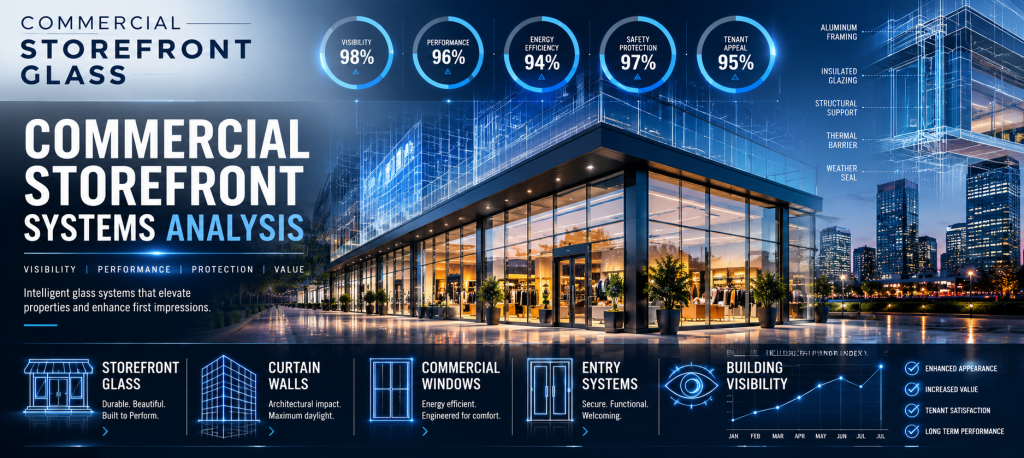
A commercial storefront system functions as a complete assembly.
Glass alone cannot resist wind loads.
Aluminum framing distributes structural forces.
Anchoring systems transfer loads into surrounding construction.
Gaskets and sealants maintain weather resistance.
Expansion joints accommodate thermal movement.
Every component contributes to the overall performance of the storefront.
A well-engineered system protects both the building and its occupants.
Building Height Changes Performance Requirements
As buildings grow taller, wind forces generally increase.
Low-rise retail centers often experience different loading conditions than mid-rise office buildings.
High-rise towers require carefully engineered curtain wall systems capable of resisting significant structural movement while maintaining airtight and watertight performance.
Commercial storefront glass used near ground level may differ substantially from glazing systems installed higher on the same building.
Engineering decisions account for building height, exposure category, local climate, and structural design.
No single storefront system fits every project.
Weather Resistance Extends Beyond Wind
Wind and water often work together.
Strong winds can drive rain against storefront systems with tremendous force.
Proper drainage paths.
Quality sealants.
Pressure-equalized framing.
Professional installation.
These factors help prevent water intrusion while maintaining long-term durability.
Commercial storefront systems are designed to manage both structural loading and environmental exposure simultaneously.
Performance depends on the complete building envelope—not simply the glass itself.
High-Performance Systems Improve Long-Term Reliability
Modern storefront systems provide advantages well beyond structural strength.
Heavy-duty aluminum framing resists long-term fatigue.
Insulated glazing improves energy efficiency.
Laminated safety glass provides additional occupant protection.
Thermally broken framing reduces heat transfer.
Premium hardware performs reliably under repeated daily use.
Property owners benefit from reduced maintenance, improved occupant comfort, and longer service life.
Durability becomes especially valuable in regions with frequent wind events.
General Contractors Depend on Proper Engineering
Commercial storefront installation requires close coordination among multiple trades.
General contractors work with architects, structural engineers, glazing contractors, waterproofing specialists, and mechanical teams to ensure storefront systems integrate correctly into the building envelope.
Field measurements.
Engineering calculations.
Anchor placement.
Expansion allowances.
Installation sequencing.
Each step influences how well the storefront performs under wind loading throughout its lifespan.
Quality installation is just as important as quality materials.
Different Building Types Face Different Challenges
Every commercial property experiences unique performance demands.
Office buildings require efficient, comfortable work environments.
Retail storefronts must combine visibility with durability.
Hotels need inviting entrances that withstand heavy traffic and changing weather.
Healthcare facilities prioritize occupant safety and uninterrupted operation.
Industrial buildings require durable systems capable of handling demanding environments.
Mixed-use developments combine several occupancy types within one building envelope.
Commercial storefront glass can be engineered to meet each of these performance requirements.
Long-Term Performance Protects Commercial Investments
A storefront represents one of the largest visible components of a commercial building.
When properly engineered for wind exposure, it contributes to:
Lower maintenance costs.
Improved weather resistance.
Greater occupant comfort.
Reduced air infiltration.
Longer system lifespan.
Higher property value.
Investing in a storefront system designed for local wind conditions helps protect the building for decades while supporting operational efficiency.
Wind Exposure—Engineering Commercial Storefront Glass for Long-Term Performance
Wind is an unavoidable part of every commercial building’s environment, but it does not have to become a long-term problem. Modern commercial storefront systems are engineered to withstand changing weather conditions while maintaining structural integrity, energy efficiency, occupant comfort, and architectural appearance.
For developers, architects, property owners, facility managers, and general contractors, understanding wind exposure is essential when selecting commercial storefront glass. Proper engineering, quality materials, and professional installation create storefront systems capable of performing reliably through years of daily use and severe weather.
Whether serving a coastal office tower, downtown high-rise, suburban retail center, healthcare campus, industrial headquarters, or mixed-use development, commercial storefront glass transforms wind from a design challenge into a performance advantage—protecting both the building and the investment behind it.


