


Tenant Improvement Glass Doors: Types, Hardware, Safety & Installation
Tenant improvement glass doors appear at the entrance and throughout the interior of a modern build-out. The type, the hardware, and the safety details differ by location, and each has code requirements that a contractor confirms during design.
This article covers the common door types, the hardware that goes with them, and how doors are installed in a build-out.
Types of Tenant Improvement Glass Doors
Most projects use a mix of these:
- All-glass entrance doors: frameless tempered doors with patch fittings, at the storefront
- Framed entrance doors: aluminum-framed glass doors matching the storefront system
- Automatic sliding and swing entrances: for accessibility and high traffic
- Interior framed glass doors: matching office-front partitions
- Sliding and barn-style interior doors: space-saving for offices and huddle rooms
Hardware and Access Control
Entrance doors need closers or operators, locks, panic or exit hardware where required, and often access control tied to the building system. Interior doors take passage or privacy sets, closers where needed, and occasionally electric strikes. The contractor coordinates power and low-voltage for any powered hardware.
Safety and ADA Requirements
Door glass and sidelites must be safety glazing. Entrances must meet ADA Accessibility Standards for clear width, maneuvering clearance, threshold height, and opening force. Automatic operators are the usual way to meet opening-force limits on heavier doors.
How Glass Doors Install
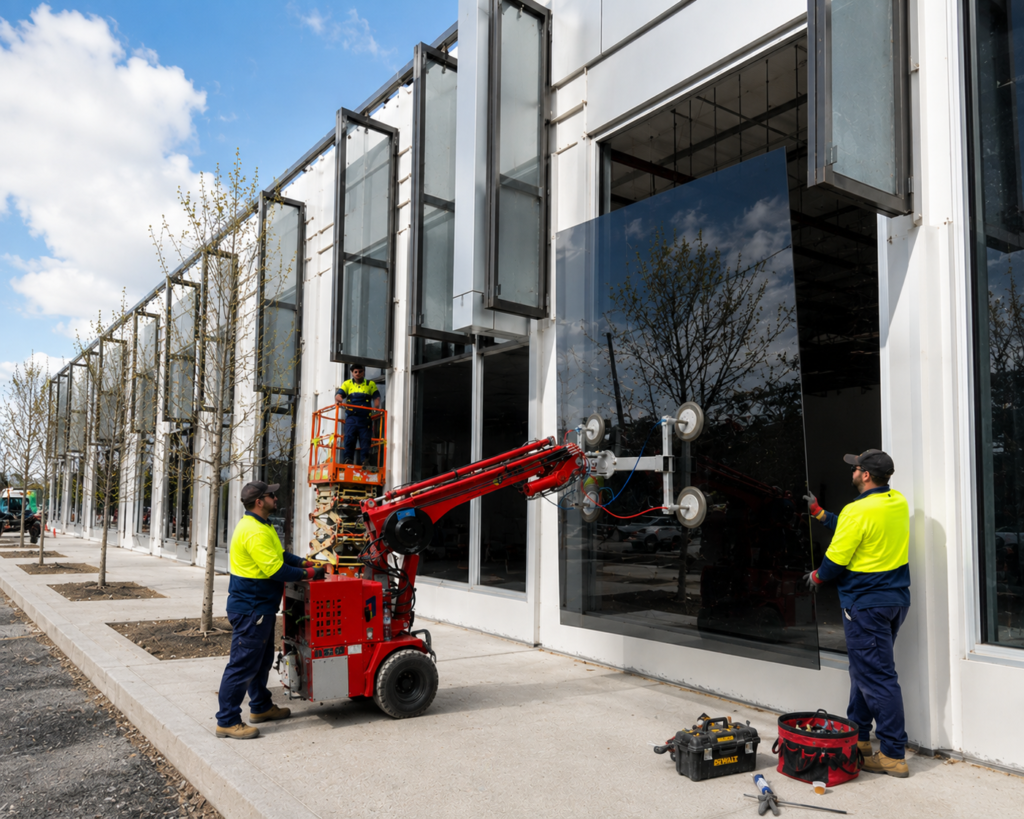
Door frames and headers are set with the storefront or partition, blocking is placed during framing, and doors are hung after drywall and floor finish so the undercut and swing are correct. Final hardware adjustment happens at closeout. This is part of the glass entry systems scope.
Door Hardware Coordination
Tenant improvement glass doors depend on a clear hardware schedule produced during design. It lists every door, its function, the lockset or exit device, the closer or operator, and any electrified components tied to access control or the fire alarm.
The contractor uses that schedule to coordinate electrical rough-in, low-voltage cabling, and the fire-alarm interface long before the doors arrive.
Maintaining Glass Doors
Tenant improvement glass doors need annual service: adjust closers and operators to the correct opening force, check pivots and patch fittings for wear, and confirm locks and exit devices work smoothly. A door that is out of adjustment is both an accessibility problem and a security risk.
Bottom Line for Commercial Property Owners
A well-managed tenant improvement glass doors decision protects three things at once: your construction schedule, your build-out budget, and the long-term performance of the space. Getting it right early, with a contractor who has done it many times, is far cheaper than correcting it later.
Every commercial building reaches these decision points. The owners and tenants who plan for them, document the scope, and work with an experienced team consistently open on time, stay on budget, and end up with space that leases and performs better for years.
Key Takeaways
- Projects mix all-glass, framed, automatic, and sliding doors
- Powered hardware needs coordinated electrical and low-voltage
- Door glass and sidelites must be tempered or laminated
- Entrances must meet ADA clear width, threshold, and opening-force rules
- Doors are hung after drywall and floor finish, then adjusted at closeout
Frequently Asked Questions
Do I need an automatic door opener?
If manual opening force exceeds the accessibility limit, or for high traffic and accessibility, yes. Your contractor tests and advises.
Can an all-glass door be locked securely?
Yes. Bottom rails with deadbolts, patch locks, and electrified hardware all provide secure locking on frameless doors.
Talk to a Commercial Glazing and Tenant Improvement Team
We supply and install entrance and interior glass doors as part of the build-out. contact our team or see glass entry systems.