


- San Francisco vs Manhattan — West Coast Finance vs Wall Street
- San Francisco vs Miami — Pacific Gateway vs Atlantic Gateway
- San Francisco vs Boston — Innovation Coast vs Education Coast
- San Francisco vs Seattle — Bay Tech vs Emerald Tech
- San Francisco vs Chicago — Pacific Gateway vs Midwest Gateway
- San Francisco vs Vancouver — Pacific Innovation vs Pacific Gateway
- San Francisco vs Charleston — Modern Skyline vs Historic Harbor
San Francisco Commercial Building Intelligence
The San Francisco commercial real estate market is undergoing an aggressive structural reset. Data indicates a major divergence between lagging commodity real estate and outperforming premium assets. For commercial glass and glazing contractors, this market intelligence dictates where capital is flowing and which project types are driving procurement volume.
Uneven Downtown Recovery
While overall market availability numbers show signs of stabilizing, the recovery is highly fragmented across asset classes and micro-pocket geographies.
The Market Reset: Sublease availability has contracted sharply to its lowest level since 2020, dropping to roughly 15% of total availability. However, total vacancy remains high, creating a polarizing environment where properties are either completely stagnant or experiencing competitive leasing.
Glazing Action: Bidding activity is heavily concentrated on active properties undergoing rapid turnarounds, rather than widespread, district-wide developments. Contractors must heavily qualify properties and owners before committing estimating resources.

Class A Towers Outperform Older Inventory
A dramatic performance gap has widened between high-quality Class A/trophy assets and older Class B or C stock. Class A asking rents command a premium, hovering near $73 per square foot compared to the lower market average.
The Flight to Views and Quality: Premium tenants are consolidating into newer, well-located buildings that offer superior natural light, robust amenities, and floor-to-ceiling glass envelopes.
Glazing Action: This creates consistent demand for high-end interior structural glass, heavy-wall acoustic glass partition installations for premium tenant buildouts, and lobby expansions designed to defend asset valuations.
AI Leasing Activity Drives Premium Office Demand
San Francisco has solidified its position as the artificial intelligence capital, triggering an explosive surge in office leasing. The market logged massive expansion-focused leasing volume, led by major commitments from sector anchors.
The AI Footprint: Companies like Anthropic (securing massive square footage across 300, 400, and 505 Howard Street) and OpenAI (expanding its footprint across Mission Bay, including 1800 Owens) are driving positive net absorption. These venture-backed tenants demand dense, collaborative, move-in-ready spaces.
Glazing Action: High-velocity Tenant Improvement (TI) cycles are the direct result. Glaziers are seeing accelerated project schedules for interior glass wall systems, demountable glass office fronts, and collaborative glazing configurations that support high-density tech workflows.
[VC Capital Influx] --> [Massive AI Lease Expansions] --> [High-Velocity TI Glazing Cycles]
Commercial-to-Residential Conversions
With city-backed tax incentives and fee waivers target-launched to streamline the transition of underutilized commercial assets into residential housing, adaptive reuse has moved from theory to an active construction pipeline.
Structural Glass Overhauls: Converting a commercial office tower into multifamily housing requires fundamentally altering the building’s exterior envelope. Fixed, monolithic commercial curtain walls must be modified or replaced to incorporate operable window units that meet strict residential life-safety and ventilation codes.
Glazing Action: This involves complex, high-margin structural fieldwork that requires coordination with structural engineers to modify existing perimeter glazing tracks and anchor plates.
Ground-Floor Retail Redevelopment Focus
San Francisco’s retail sector is showing firm signs of stabilization, with vacancy improving year-over-year to 6.0% and average asking rents climbing past $35 per square foot. Capital is heavily focused on activating vacant storefronts and modifying ground-floor spaces.
Security and Transparency: Landlords are balancing the need for public-facing aesthetic appeal with asset protection. The trend focuses on removing heavy, opaque security gates and replacing them with high-performance security glazing.
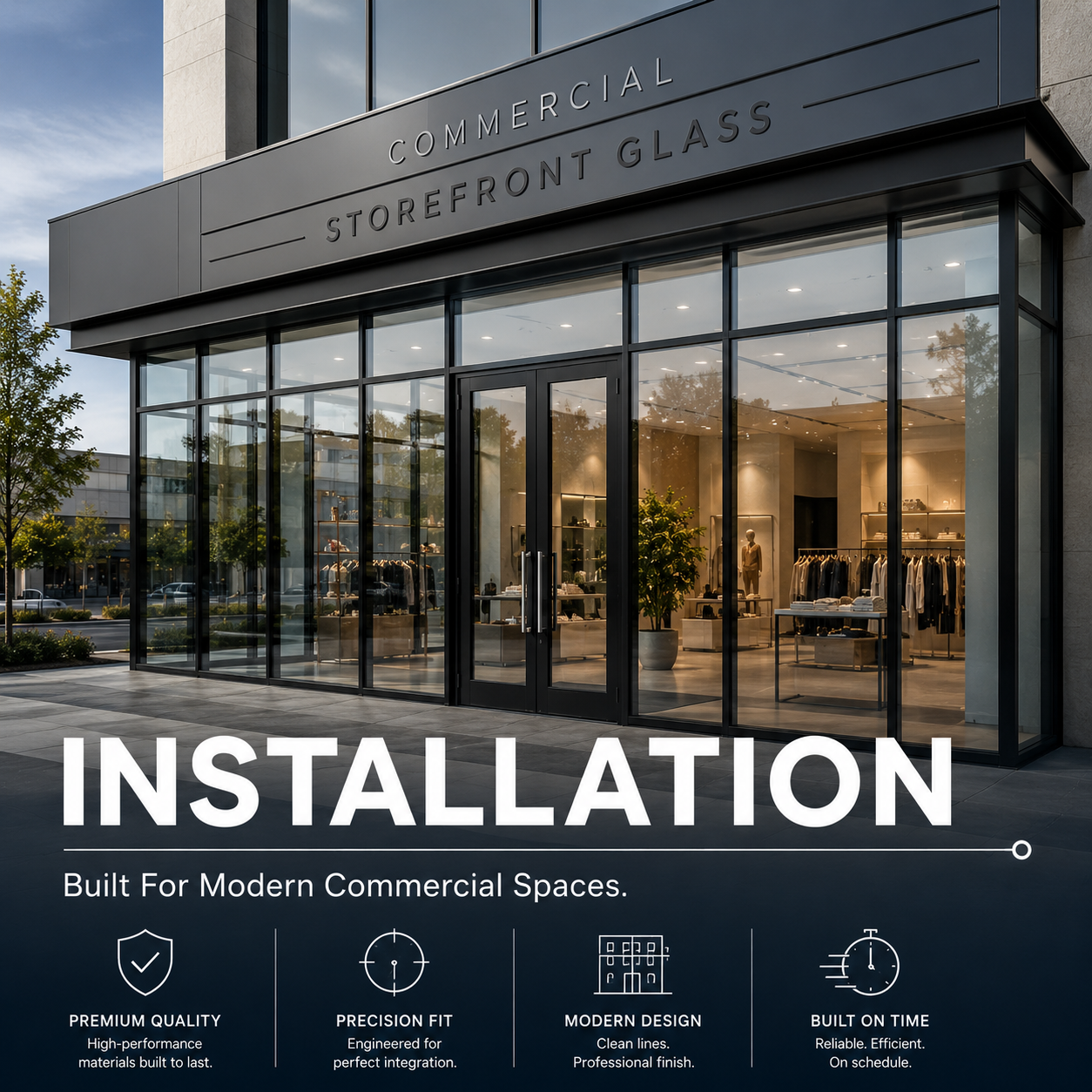
Glazing Action: Increased volume in heavy-duty laminated security glass installations, impact-resistant storefront framing assemblies, and anti-reflective glass for premium retail displays.
Energy Regulations and Modernization
California’s stringent Title 24 energy mandates are heavily influencing landlord modernization decisions. Capital improvement budgets are being systematically deployed to improve operational efficiency.
Insulated Glass Unit (IGU) Swaps: Older high-rises with failing, single-pane, or early-generation double-pane glass cannot meet modern thermal compliance standards, driving up building HVAC costs.
Glazing Action: Large-scale exterior glazing remediation projects involving the systematic replacement of failed IGUs with high-performance double- or triple-glazed units featuring advanced low-emissivity (Low-E) coatings and integrated thermal breaks.
Asset Repositioning Over New Construction
The active commercial construction pipeline for new ground-up office space in San Francisco remains at 0 square feet. Institutional capital and smart money have completely pivoted to purchasing and recapitalizing existing properties.
Value-Add Retrofits: Investors are targeting the acquisition of Tier 2 or underperforming buildings and injecting strategic capital to upgrade them into properties capable of commanding premium rental rates.
Glazing Action: This shift directly channels glazing volume away from massive contract curtain wall bidding toward core structural retrofits, including entry vestibule modernizations, structural glass fin walls, and complete interior glass buildouts.
Glazing Contractor Takeaway: The San Francisco market intelligence indicates that financial success relies on targeting asset repositioning, high-end AI tenant buildouts, and energy-driven curtain wall retrofits. The volume is found in specialized, technically demanding modifications of existing structures.
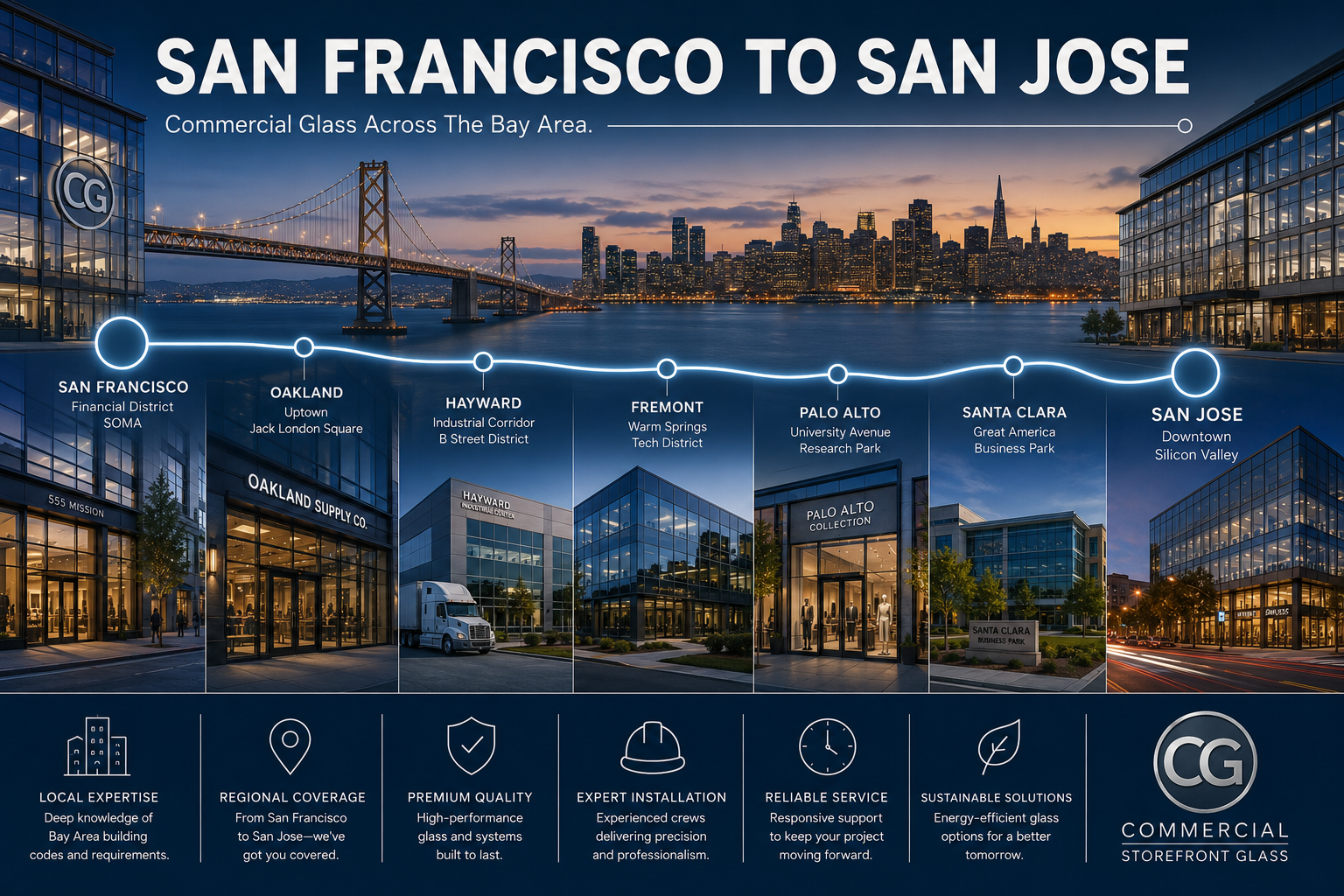
Modern storefront systems help businesses create stronger connections with customers.
Visibility supports engagement.
Natural light improves interior environments.
Exterior presentation influences first impressions.
For many commercial properties, storefront installation becomes one of the most visible investments made in the building.
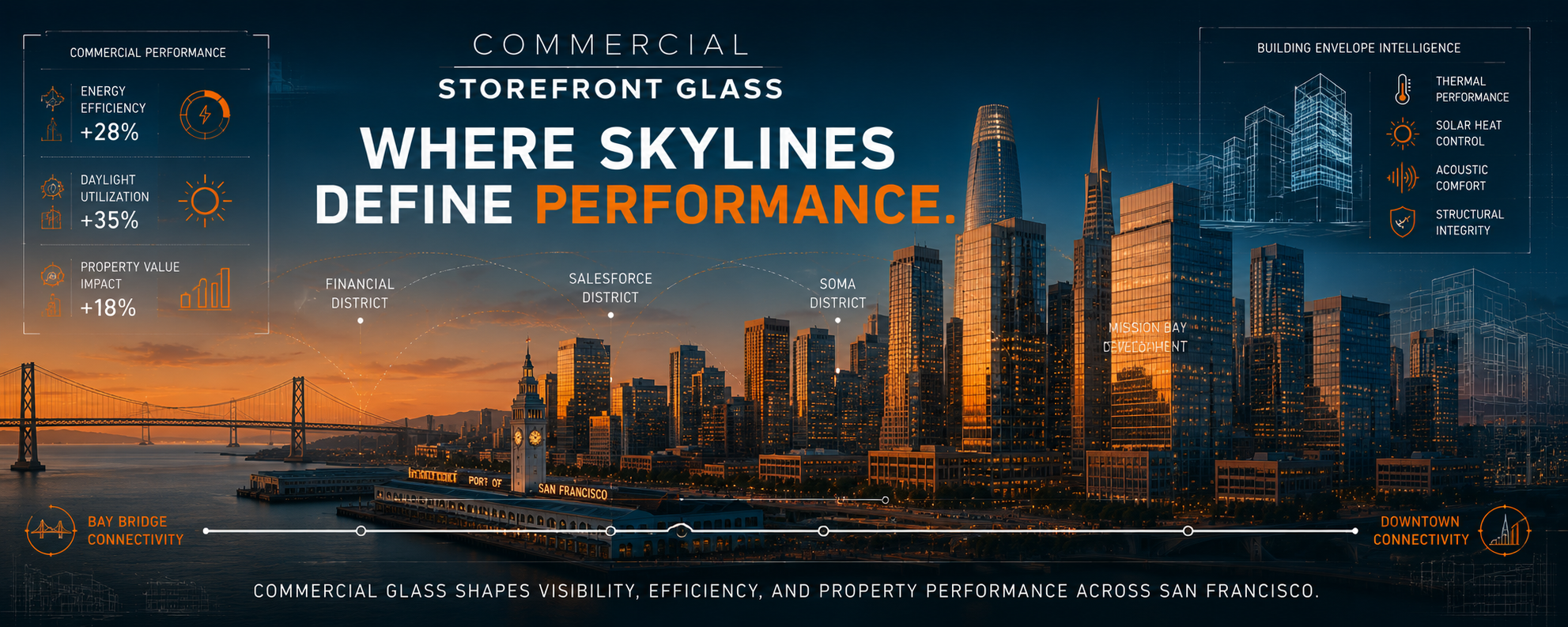
Commercial buildings continue evolving.
Tenant expectations change.
Property modernization remains ongoing.
Storefront replacement projects often support broader exterior improvements that enhance appearance and competitiveness.
Updated systems help properties remain aligned with current market demands.
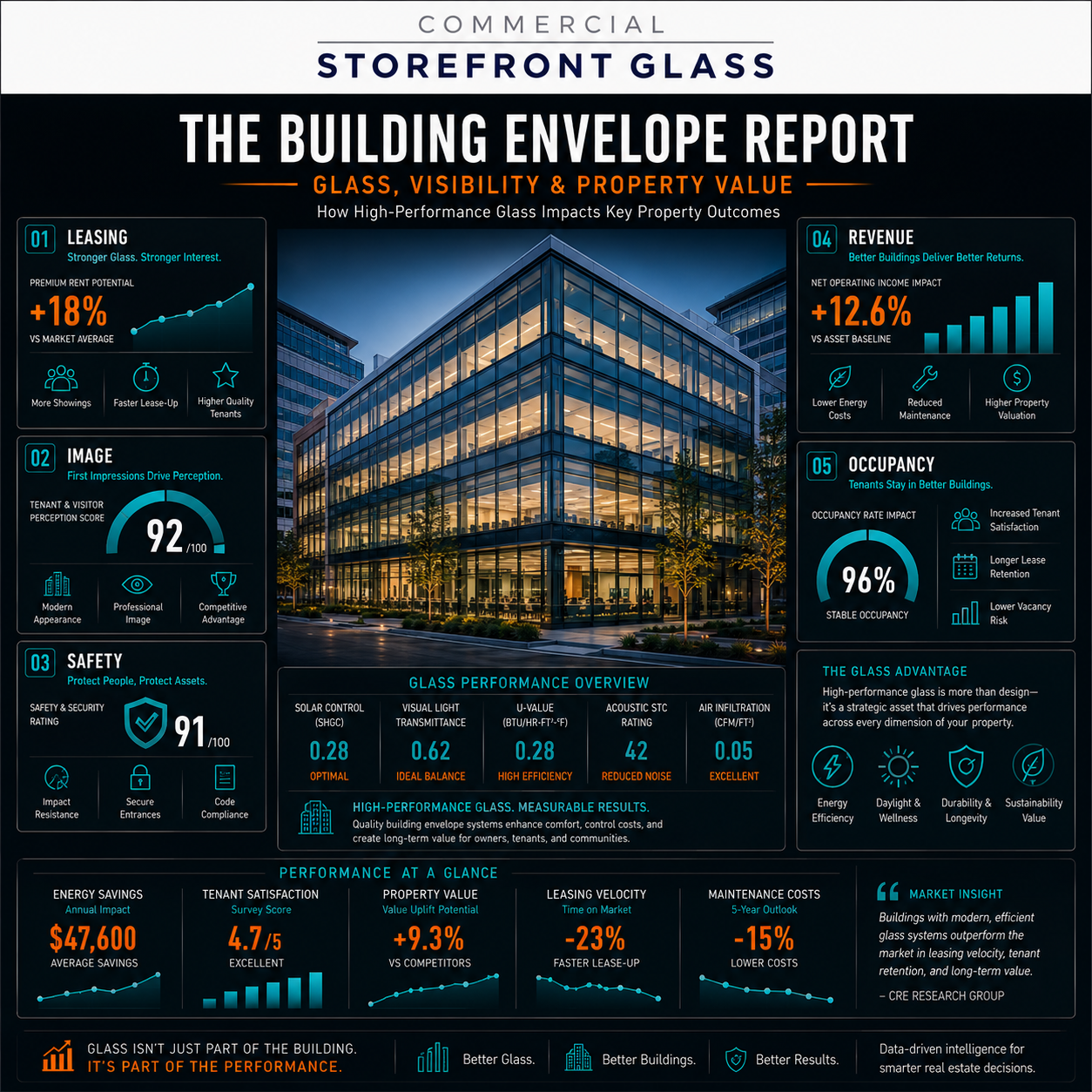
San Francisco, California
1. A Brief History of Commercial Glass in San Francisco
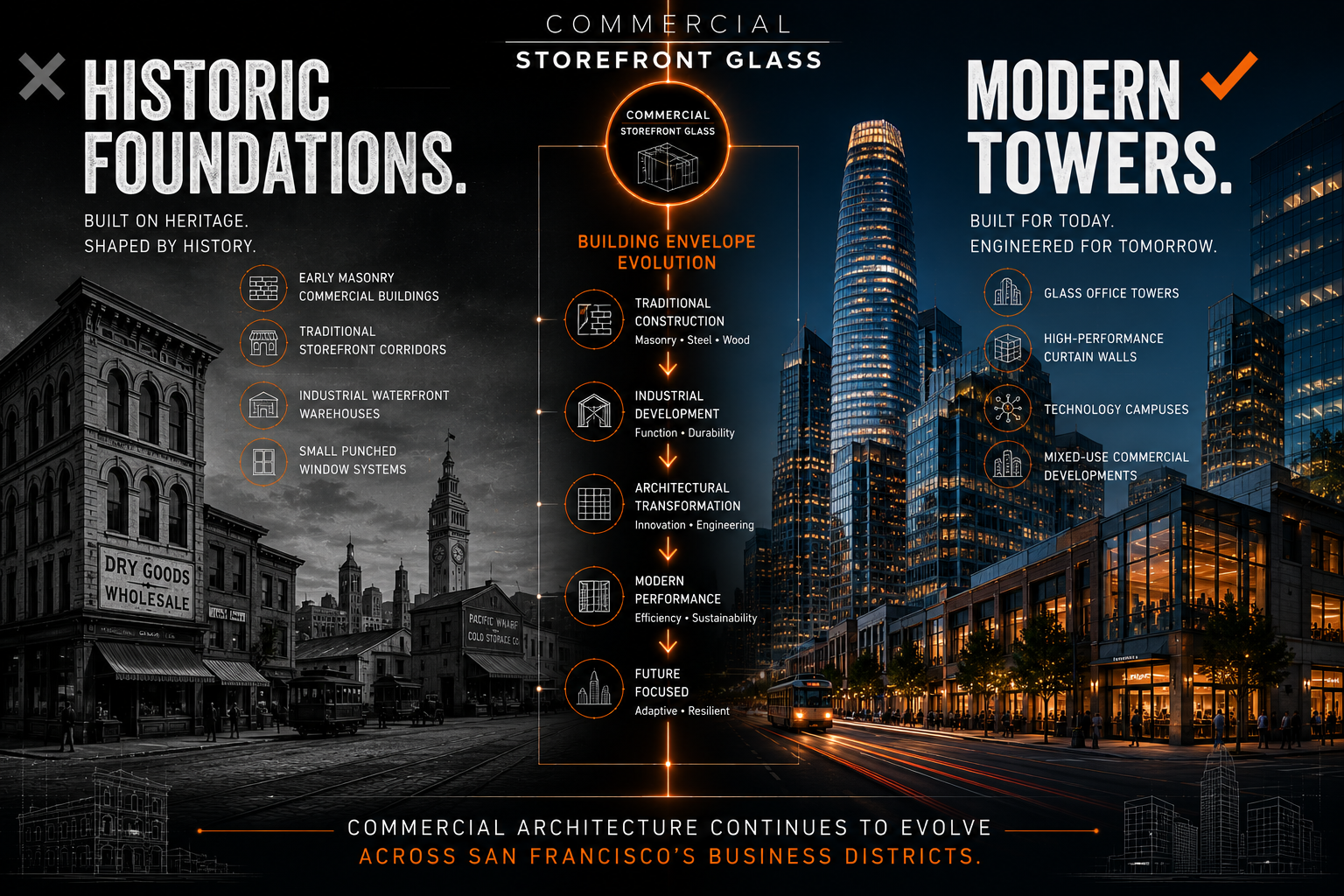
San Francisco’s commercial glass history is a story of resilience, innovation, and architectural evolution. Before 1906, the city’s commercial districts, such as the Financial District and Union Square, featured traditional masonry buildings with standard plate-glass storefronts. The 1906 Earthquake and Fire changed everything. The catastrophic shattering of miles of commercial glass proved that rigid glazing was a massive liability, prompting an immediate overhaul in architectural engineering.
During the post-earthquake reconstruction, San Francisco became a pioneer in incorporating flexible steel frames and seismic-resistant glazing. Decades later, the mid-century corporate boom transformed the skyline with the introduction of modern, glass-heavy skyscrapers. The completion of iconic structures like the One Maritime Plaza and the modern engineering feats of the Salesforce Tower pushed San Francisco to the absolute forefront of structural glass innovation, utilizing advanced unitized curtain wall systems engineered to withstand intense Pacific winds and high-magnitude tectonic shifts.
2. Why Commercial Glass Matters Here
In San Francisco, commercial glass is highly specialized due to the extreme collision of geography, microclimates, and some of the world’s strictest building regulations:
Extreme Seismic & Wind Loads: Glazing in San Francisco must be engineered for high-velocity winds sweeping in from the Pacific Ocean while remaining flexible enough to withstand significant lateral drift during an earthquake. This requires highly technical, heavy-duty aluminum framing systems with wide glazing pockets that allow glass panes to shift safely without fracturing.
Microclimates and Thermal Performance: San Francisco’s legendary fog and intense microclimates mean a building can experience cool, damp conditions on one side and direct sun on the other. High-performance Insulated Glass Units (IGUs) with advanced Low-E coatings are critical to regulating indoor temperatures, reducing reliance on HVAC systems, and hitting the city’s strict climate-neutral energy goals.
Bird-Safe Building Legislation: San Francisco was a global pioneer in adopting Bird-Safe Building Standards. Because the city sits along the Pacific Flyway migration route, commercial glass installations in new construction or major renovations near parks and the waterfront must use specialized fritted, etched, or UV-patterned glass to prevent avian collisions.
3. Primary Commercial Glass Services Needed
| Service Category | High-Demand Applications in San Francisco |
| Unitized Curtain Wall & High-Rise Glazing | Ongoing maintenance, pane replacement, and structural seal inspections for the city’s dense vertical landscape and skyscraper facades. |
| Bird-Safe & Fritted Glass Retrofits | Modifying or replacing existing glass on waterfront and park-adjacent commercial properties to comply with San Francisco Planning Code Section 139. |
| High-End Retail Storefronts & All-Glass Entrances | Heavy-duty structural glass facades, structural glass fins, and point-supported (spider) glass systems for premium retail corridors in Union Square and the Financial District. |
| Historical Facade & Transom Restorations | Replicating and replacing vintage or textured commercial glass within historic cast-iron and brick buildings in districts like Jackson Square and the Tenderloin. |
| High-STC Interior Acoustic Glass | Installing laminated interior glass walls and soundproof conference rooms to isolate sound in dense, open-concept corporate headquarters and tech offices. |
Daily operations place constant demands on commercial glazing systems.
Hardware occasionally fails.
Operational issues may affect entrances and storefronts.
Prompt repairs help restore functionality while protecting both appearance and customer experience.
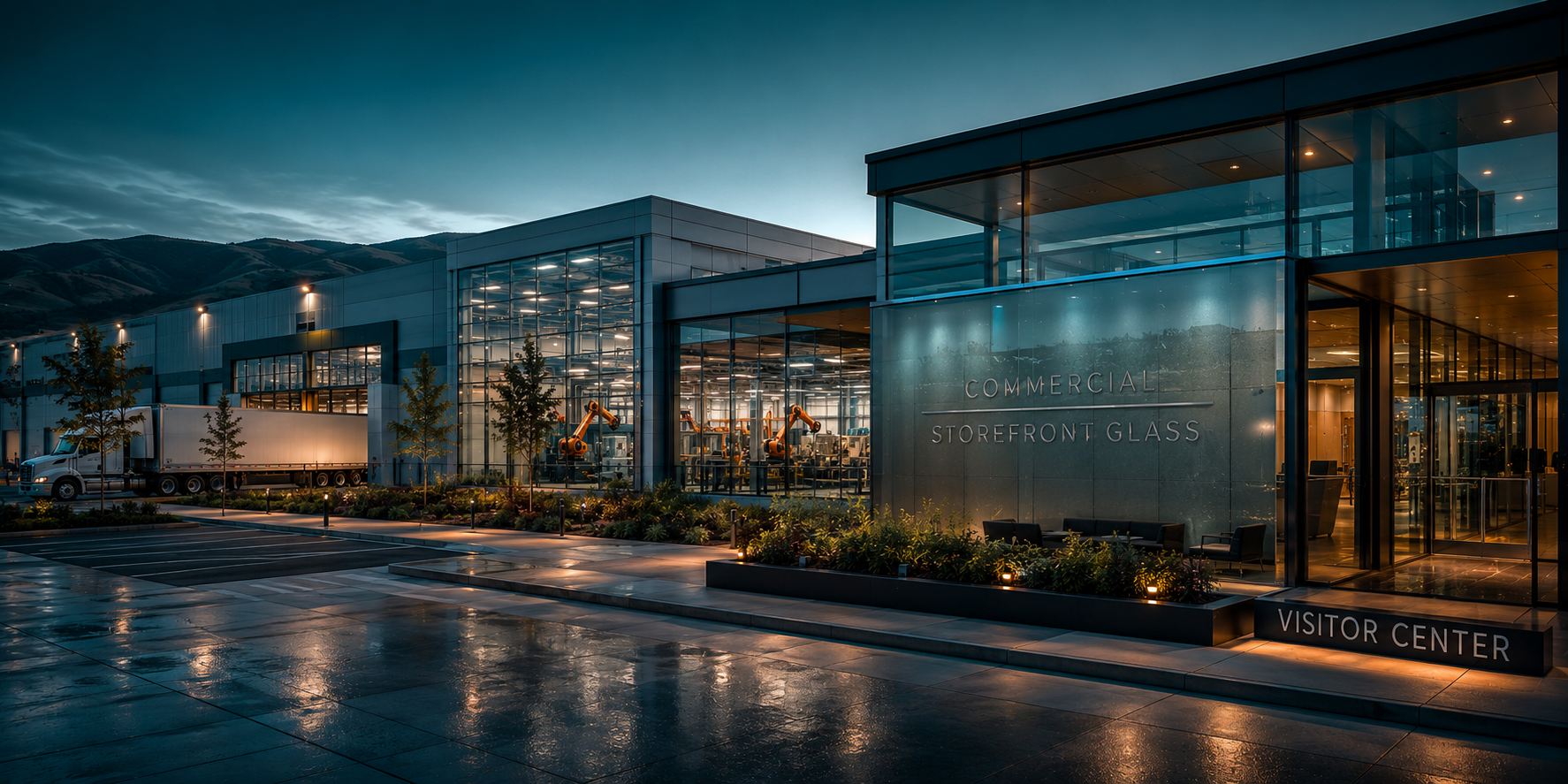
Understanding San Francisco’s Building Inventory
Distinct architectural eras define the San Francisco commercial landscape. For commercial glass and glazing contractors, each building type represents a specific set of engineering challenges, framing requirements, and glass performance specifications.
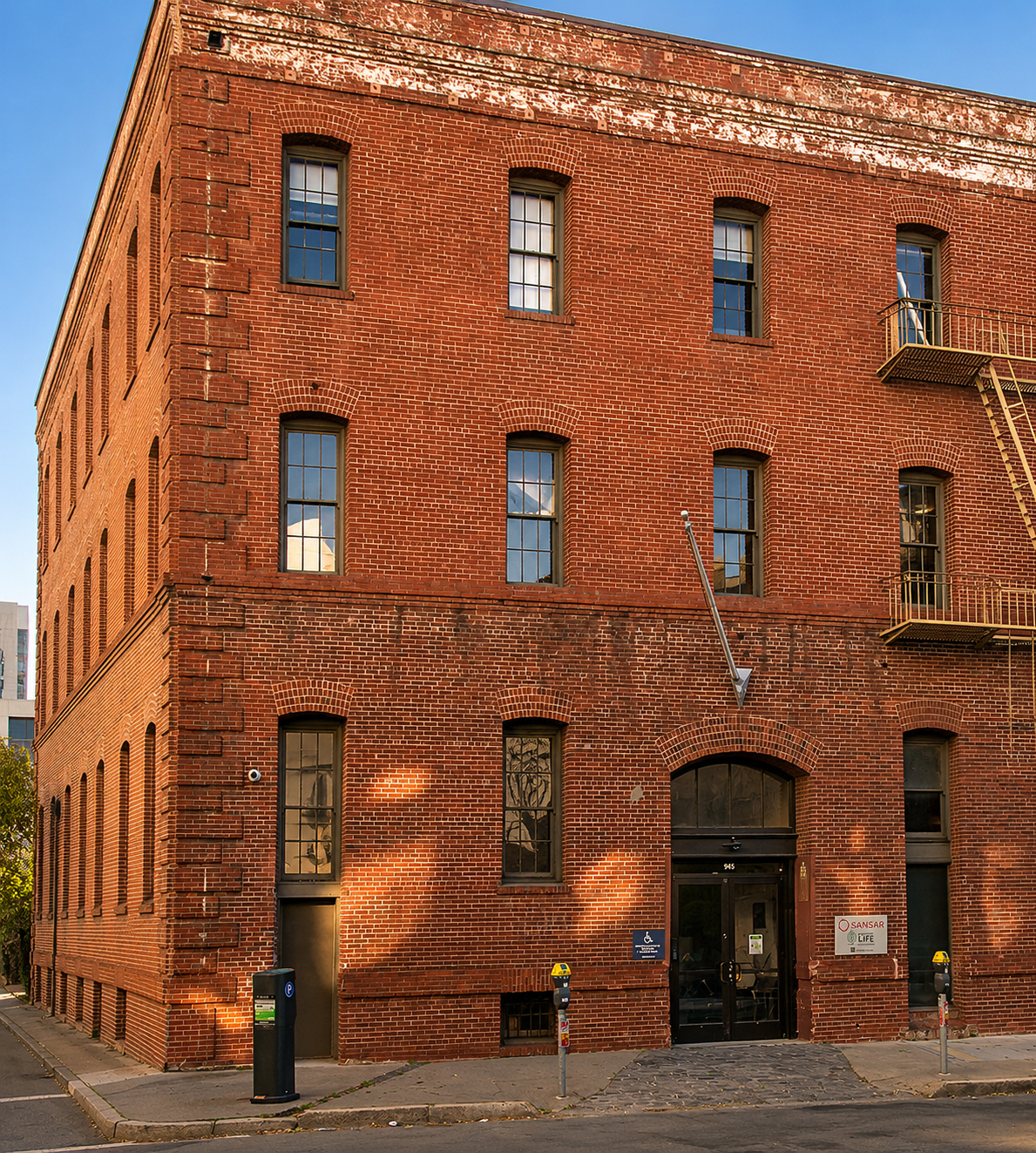
Historic Brick Commercial Buildings
Concentrated in Jackson Square, SoMa, and the Northeast Waterfront, these early 1900s masonry structures are highly sought after for creative offices and boutique retail.
Glazing Profile: Upgrades require matching strict historic preservation codes while enhancing structural performance.
Scope & Specs: Installing industrial-style steel or thermally broken aluminum frames (Crittall style) inside original masonry openings. Projects frequently involve custom entry vestibules, large interior glass partitions to preserve exposed brick sightlines, and high-performance laminated acoustic glass to mitigate street noise.
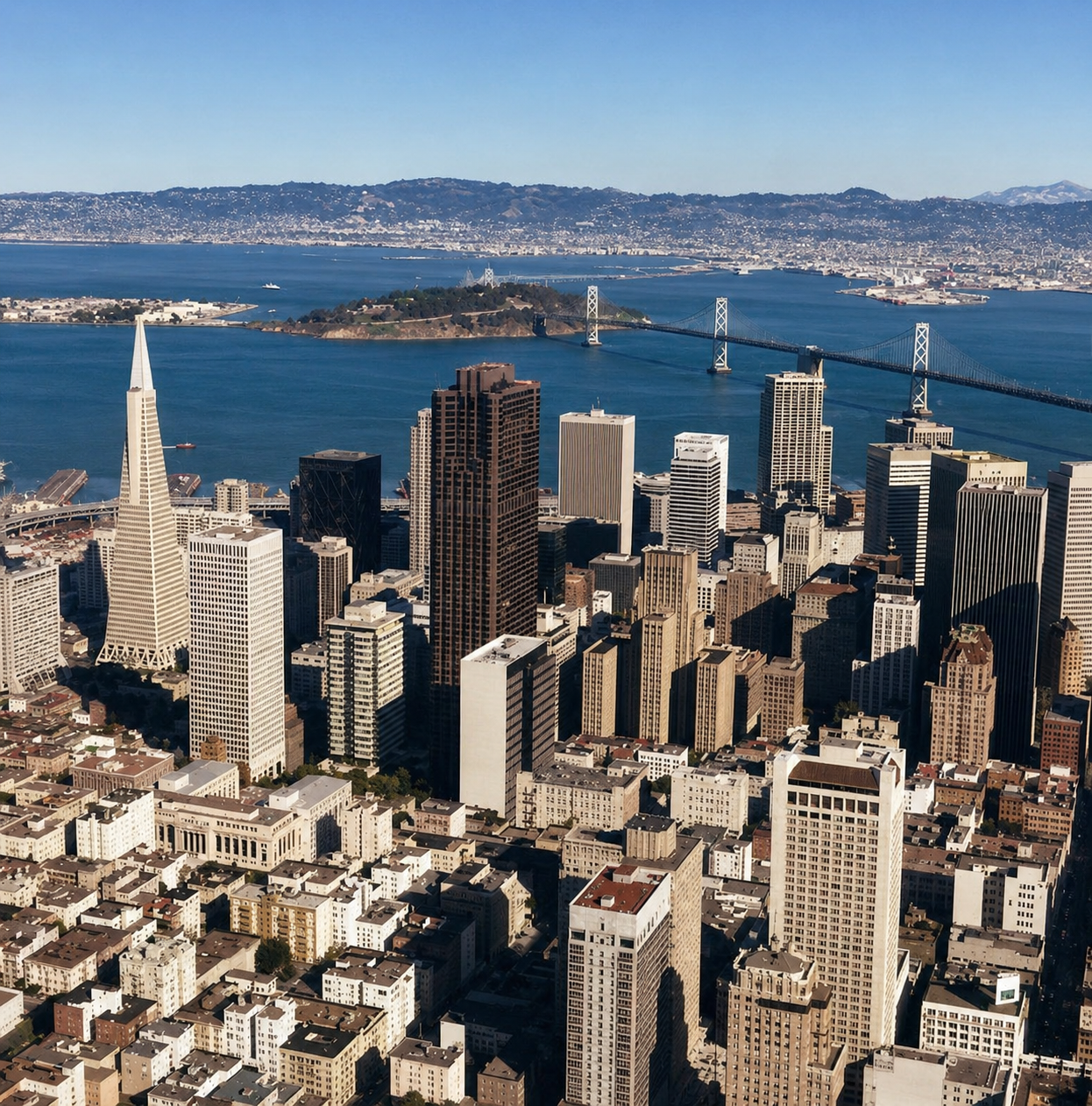
Mid-Century Office Towers
Built between the 1950s and late 1970s across the Financial District, these properties feature punch-window configurations or early-generation, non-thermal curtain walls with heavy steel or aluminum framing.
Glazing Profile: These assets are the primary targets for energy-efficiency retrofits to comply with modern building operational standards.
Scope & Specs: Systematic replacement of single-pane or failing double-pane glass with modern insulated glass units (IGUs). Glaziers must integrate high-performance low-emissivity (Low-E) coatings and repair or upgrade perimeter gaskets and structural seals to eliminate moisture infiltration and thermal bridging.
Post-1980 Curtain Wall Assets
These modern high-rises dominate the Financial District and South to Mission Street, characterized by expansive, floor-to-ceiling unitized curtain walls, structural silicone glazing (SSG), and large glass spans.
Glazing Profile: Highly active due to the “flight to quality,” where landlords are investing in aesthetic and performance updates to attract premium tech and AI tenants.
Scope & Specs: Large-scale lobby modernizations utilizing point-supported structural glass fins, ultra-clear low-iron glass facades, and heavy-duty revolving doors. Interior work focuses on dense tenant improvements, requiring high-STC (Sound Transmission Class) acoustic glass partitions and frameless glass slider systems.
Mission Bay Life Science Campuses
A modern, master-planned submarket comprised of ground-up, low-to-mid-rise laboratory, research, and healthcare facilities.
Glazing Profile: Highly technical environments where glazing specifications are tied directly to building life-safety and environmental controls.
Scope & Specs: High-performance unitized curtain walls with strict solar heat gain coefficients (SHGC), electrochromic smart glass that dynamically adjusts tint, blast-resistant glazing assemblies, and specialized interior clean-room glass partitions.
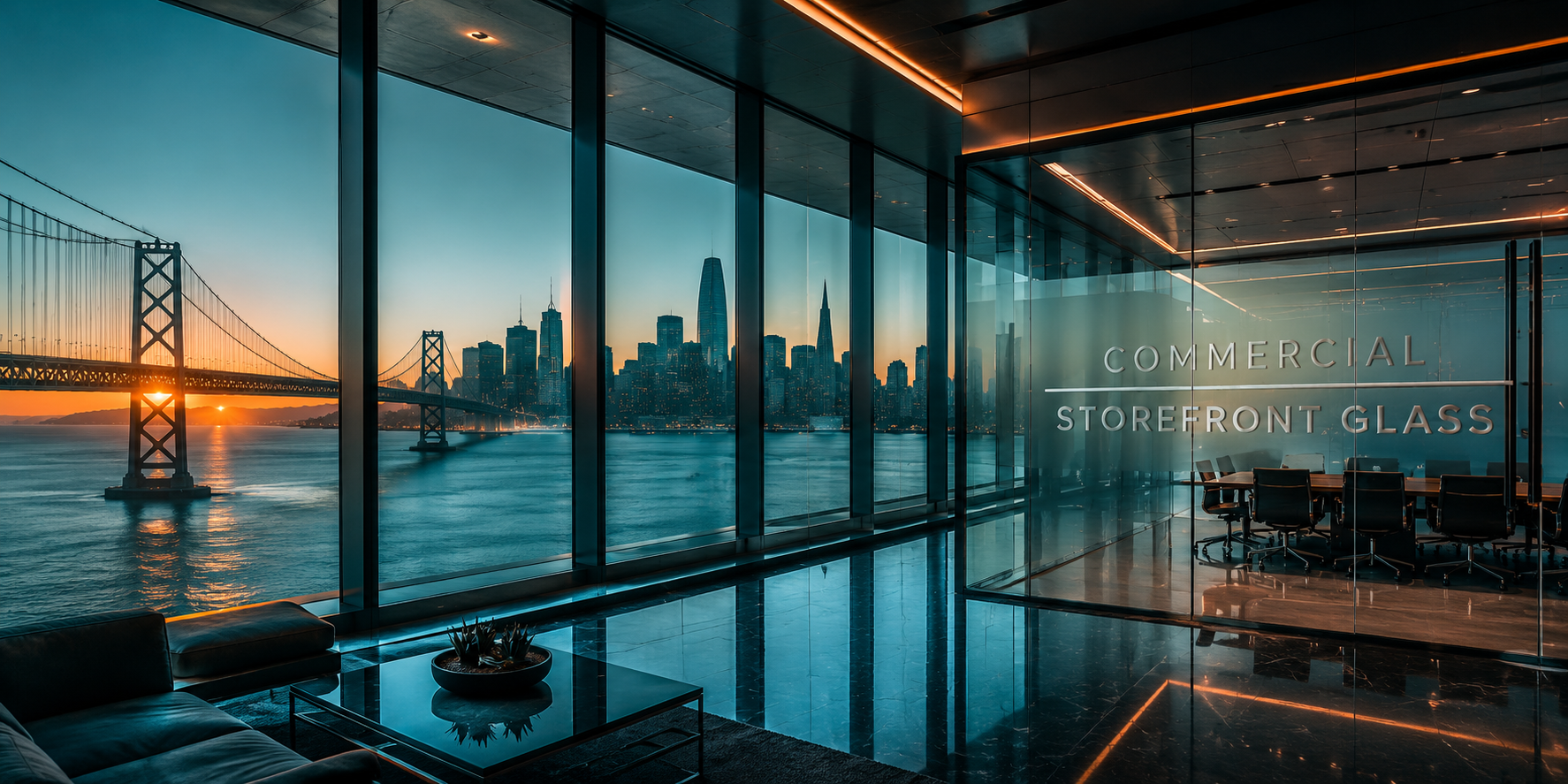
Waterfront Commercial Properties
Stretching along the Embarcadero and historic pier infrastructures, these low-rise commercial developments face harsh environmental exposure.
Glazing Profile: Systems must be engineered to withstand severe weather, high wind loads, and marine air corrosion.
Scope & Specs: Heavy-duty anodized aluminum framing systems with marine-grade corrosion resistance, impact-rated laminated glass, and advanced hydrophobic glass coatings to minimize salt and moisture buildup.
Mixed-Use Redevelopment Projects
Adaptive reuse developments transforming older commercial and industrial complexes into multi-family residential, retail, and agile workspaces.
Glazing Profile: Conversions require modifying commercial exterior envelopes to meet residential building codes.
Scope & Specs: Retrofitting fixed commercial curtain walls to accept operable awning or casement window units for natural ventilation. This fieldwork involves structurally modifying perimeter glazing tracks, anchor plates, and window line configurations.
Contractor Takeaway: Success in the San Francisco market requires a diversified technical approach. Mid-century towers dictate high-volume IGU replacement and thermal remediation, post-1980 assets drive premium structural entryways, and historic or mixed-use conversions require complex, customized architectural metal and glazing fieldwork.

Entrances influence how people experience a property.
Visitors notice them immediately.
Employees use them daily.
Customers interact with them constantly.
Modern glass entry systems help support accessibility, visibility, security, and long-term performance.
Unexpected damage can expose a property to additional risk.
Vehicle impacts, vandalism, storms, and break-ins often require immediate protection.
Emergency board-up services help secure damaged openings while permanent repairs or replacement plans are arranged.
Protecting occupants and business operations becomes the immediate priority.
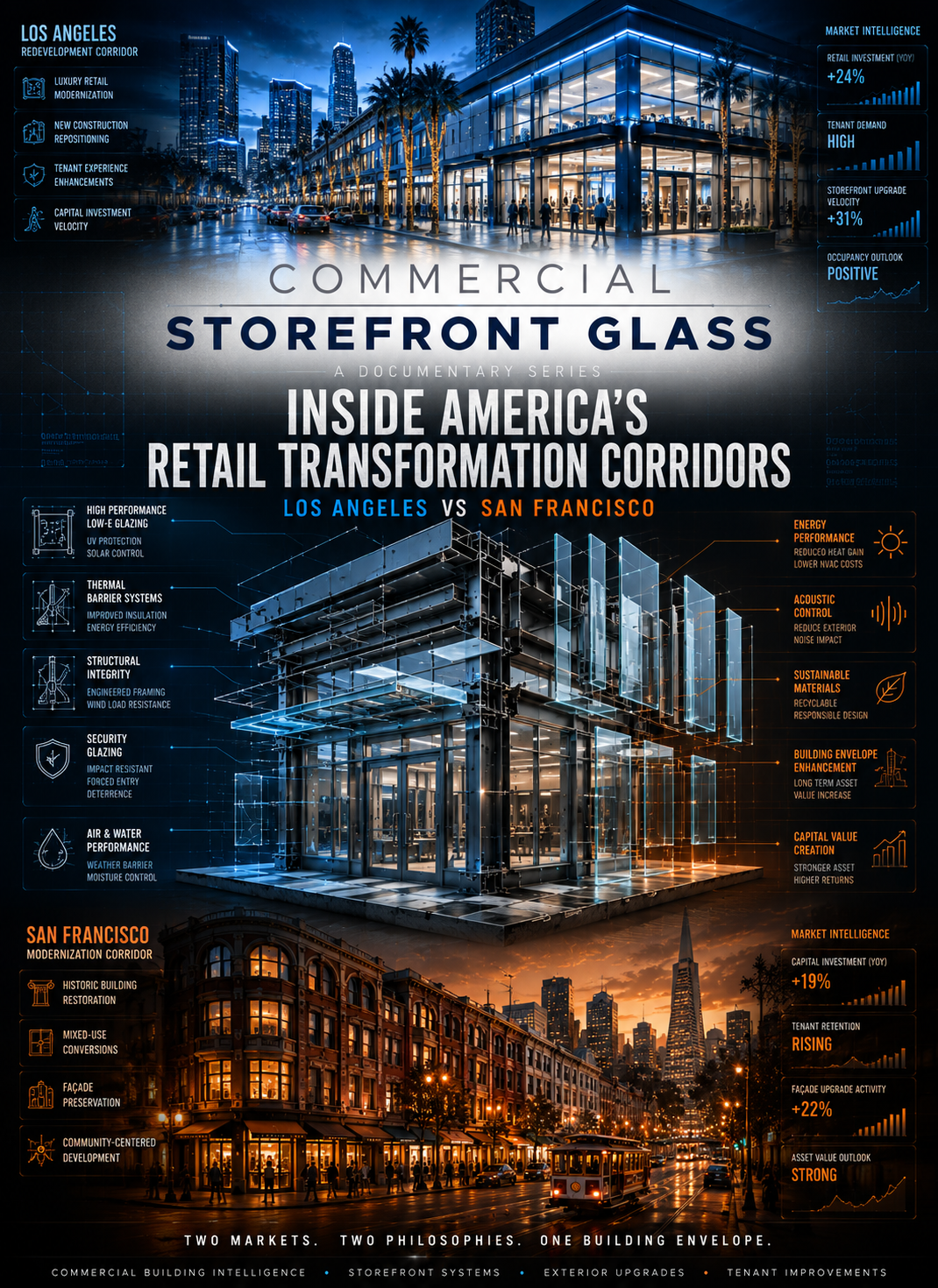
Office properties remain a defining part of San Francisco’s commercial landscape.
Workplace quality influences tenant attraction.
Natural light contributes to employee experience.
Architectural glazing shapes building identity.
Modern glass systems often support long-term competitiveness while improving overall property performance.
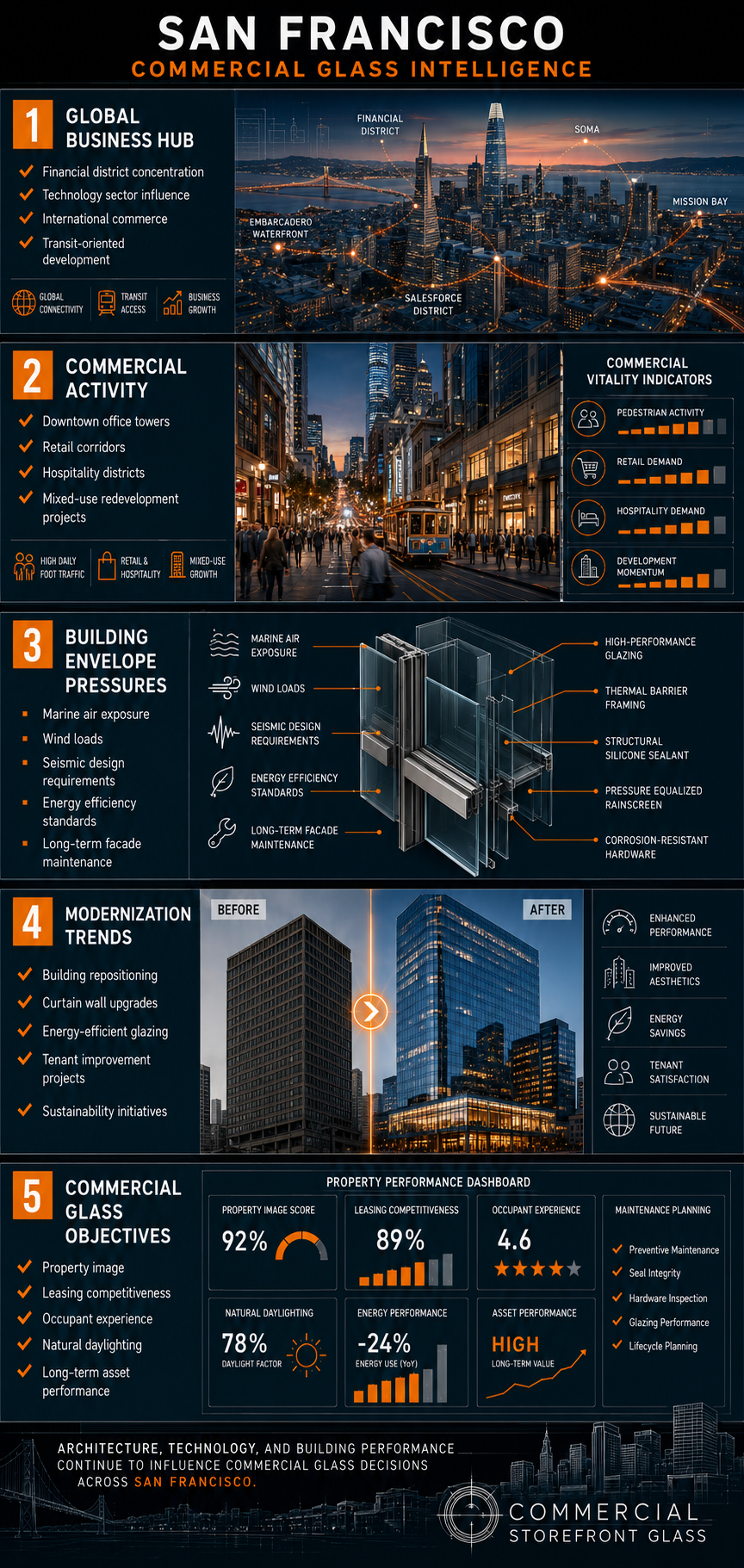
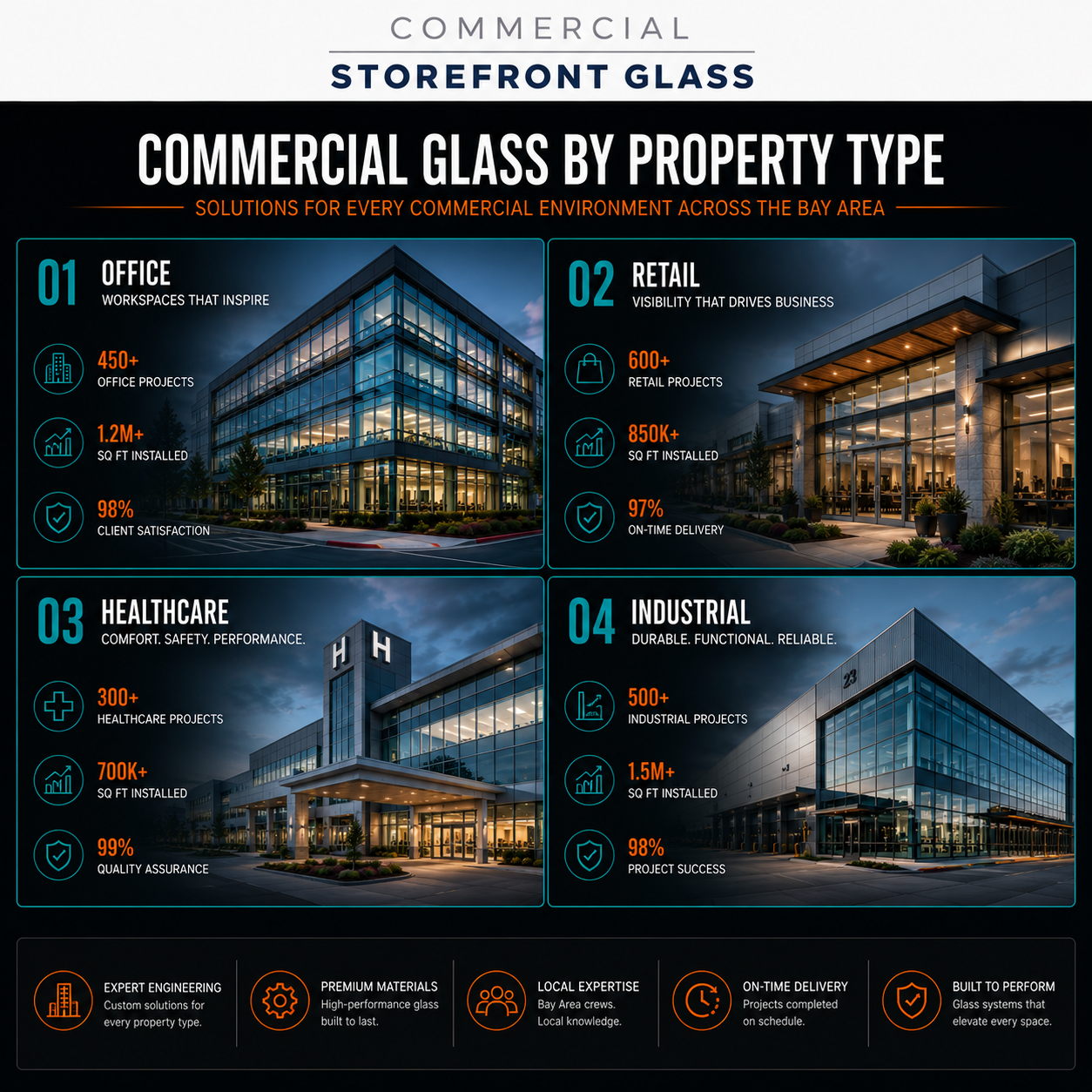
San Francisco supports one of the most diverse commercial property markets in California.
Each sector faces different priorities.
Tenant attraction may drive one project.
Customer experience may influence another.
Long-term building performance remains important across all of them.
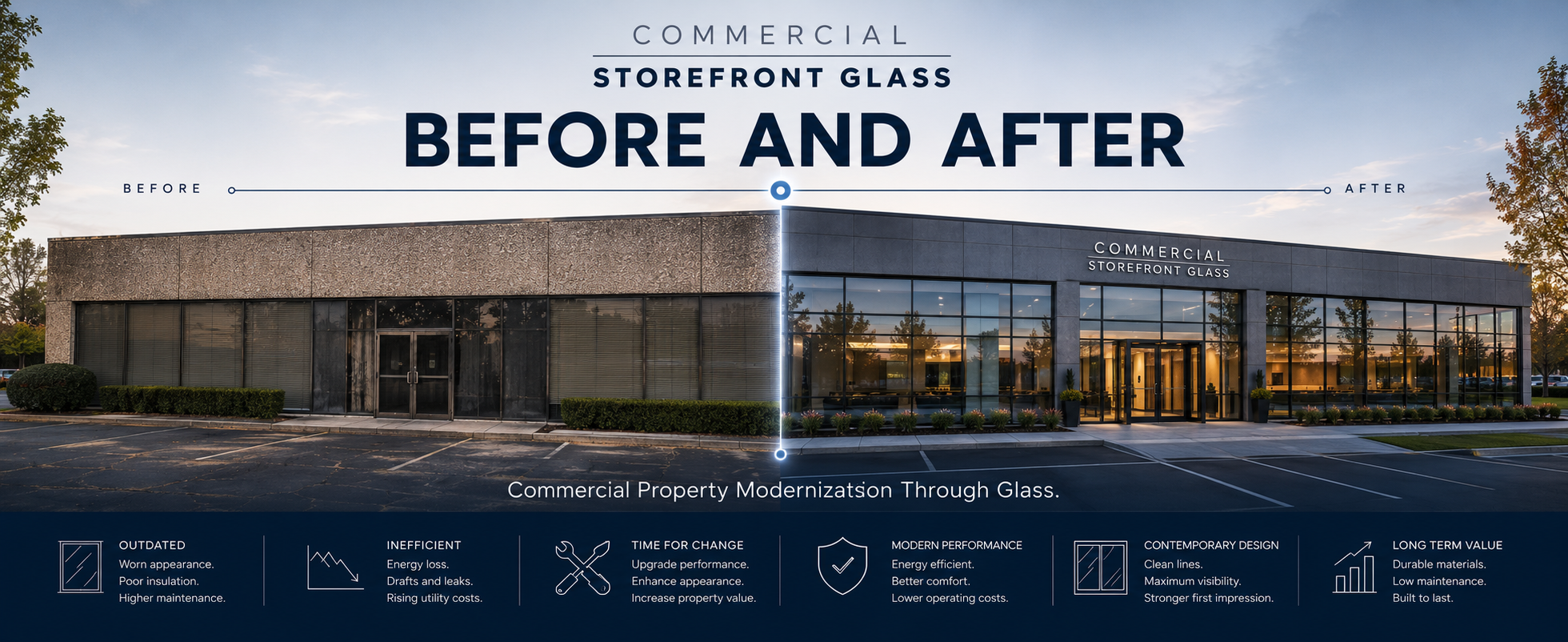
Commercial Glass & Glazing: San Francisco Focus
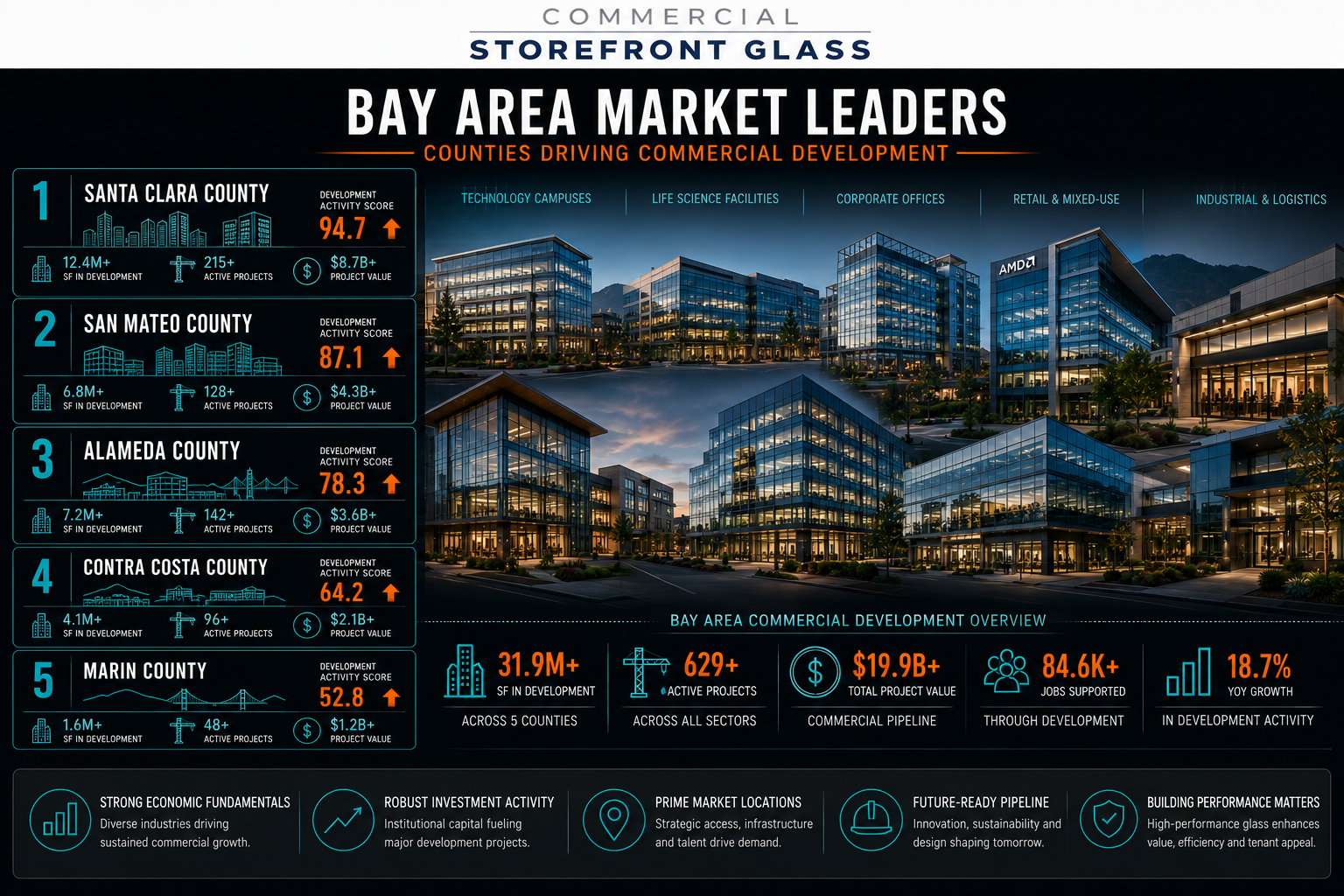
San Francisco’s commercial real estate landscape is undergoing a massive structural shift. High vacancy rates are driving a pivot away from massive new tower construction toward the optimization, transformation, and adaptive reuse of existing square footage. For the glass and glazing industry, this represents a major volume driver across distinct market sectors.
Office Repositioning & Adaptive Reuse
With the city actively incentivizing commercial-to-residential conversions (including major local fee and tax waivers on the first 7 million square feet of conversions), building envelopes are being radically altered.
Façade Conversions: Shifting commercial properties to residential or mixed-use requires replacing fixed, monolithic commercial curtain walls with operable, high-performance glazing systems to meet residential ventilation and life-safety codes.
Thermal & Sustainability Retrofits: Glaziers are tapped to swap out aging, inefficient single- or double-pane glass installed before 2000. Upgrades focus on smart glazing, low-E coatings, and advanced thermal breaks to align older buildings with strict California Title 24 energy mandates.
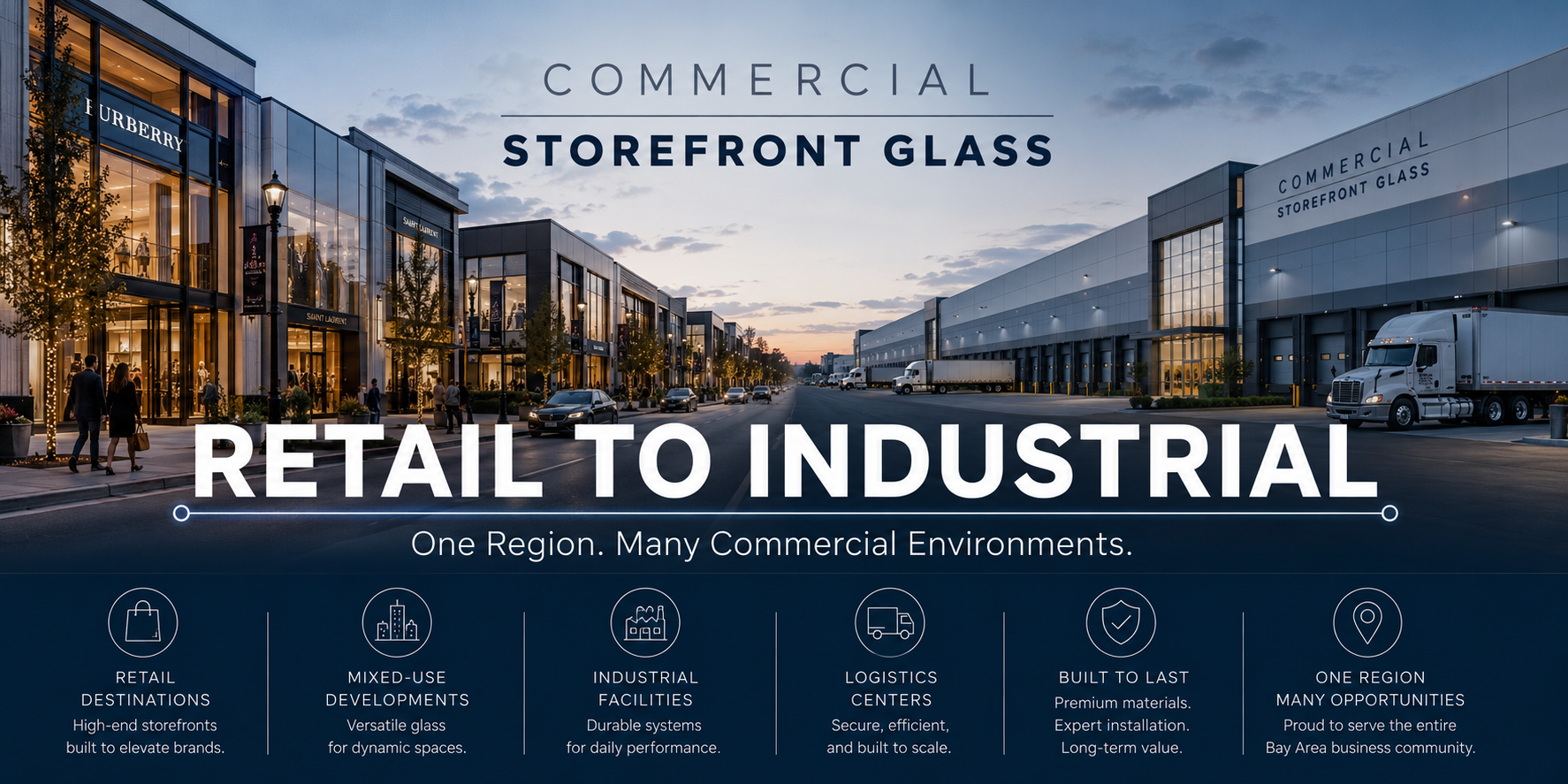
Class A Buildings: The Flight to Quality
Class A and trophy assets are performing noticeably better than Class B or C spaces as landlords compete fiercely for premium tenants, particularly in the surging Artificial Intelligence (AI) sector.
Premium Storefronts & Lobbies: To maintain asset value, Class A landlords are investing heavily in street-level visual appeal. This includes installing ultra-clear, low-iron structural glass fins, oversized glass entryways, and heavy-duty revolving doors.
Acoustic & Daylight Optimization: High-end tenants demand maximum natural light combined with superior acoustic attenuation (sound dampening) to block out urban street noise, driving the specification of laminated, multi-layered acoustic glass.
Tenant Improvement (TI) Cycles
While massive corporate campus build-outs have slowed, smaller-cap, agile Tenant Improvement projects are highly active as companies right-size and reconfigure their physical footprints.
Interior Glazing Demand: Modern TI designs heavily favor interior glass partitions, demountable glass walls, and glazed conference rooms to maintain an open feel while providing acoustic privacy.
Speed to Market: Local glazing sub-contractors specializing in rapid-turnaround interior fit-outs, glass entrances, and customized architectural metal framing see consistent volume here.
Downtown Recovery Dynamics
San Francisco’s downtown market has bottomed out and is stabilizing, with a sharp rise in year-over-year leasing volume and active tenant requirements.
Security & Resilience Upgrades: Downtown retail and ground-floor commercial spaces are prioritizing security glazing. This includes widespread retrofitting with laminated security glass, impact-resistant storefront systems, and poly-carbonate glazing lines to protect assets while maintaining clean visual lines.
Activation of Vacant Spaces: Programs that convert vacant ground floors into pop-ups, community spaces, or neighborhood retail require rapid storefront remediation, glass replacement, and entrance door repairs.
Market Takeaway: The SF glazing market has shifted from a new-construction volume model to a highly technical, specialized retrofit and interior build-out market. Success relies on navigating complex structural modifications and meeting stringent California energy and safety codes.
Corporate Campuses
Technology companies and major employers continue investing in workplace environments.
Employee experience influences design decisions.
Modernization supports competitiveness.
Commercial glass systems help create bright, collaborative, and contemporary workspaces.
Mission Bay and the surrounding innovation districts continue to expand.
Research facilities require modern environments.
Laboratory campuses support scientific advancement.
Commercial glazing contributes to both architectural design and workplace quality throughout these developments.
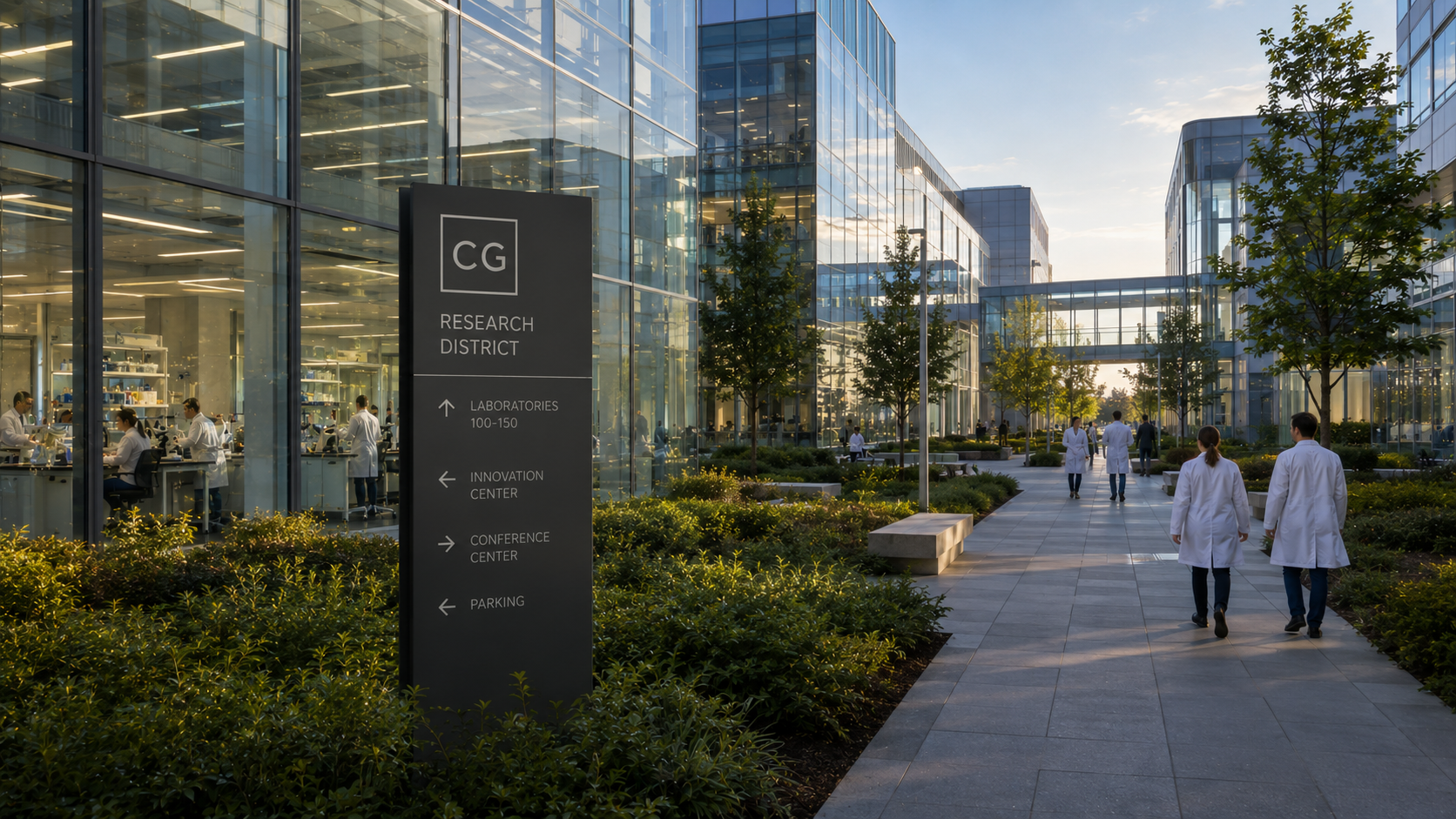
The “Flight to Quality” in San Francisco Commercial Real Estate
The commercial real estate market in San Francisco is experiencing a sharp divergence. While older, un-renovated Class B and C properties face historic vacancies, Class A and trophy assets are capturing the vast majority of new leasing velocity, driven primarily by the expansion of venture-backed Artificial Intelligence (AI) and technology firms.
For the commercial glass and glazing industry, this “flight to quality” has shifted the market focus away from new high-rise construction and toward premium capital expenditures on building envelopes, structural entryways, and luxury interior buildouts.
Why Class A Outperforms Class B
San Francisco’s office market is stabilizing, driven by a surge in leasing volume from the AI sector. However, this demand is highly concentrated in premium spaces due to two primary market factors:
Rent Convergence: A reset in commercial valuations has brought prime Class A rents closer to market averages. Premium tenants are taking advantage of this alignment to secure top-tier spaces that were financially inaccessible in previous economic cycles.
Talent Recruitment and Retention: Technology firms view physical office space as a critical tool for collaboration and recruitment. Class B properties with standard ceiling heights, limited natural light, and dated infrastructure cannot deliver the high-energy, premium environments required to draw workforce talent back downtown.
The Building Amenity Wars
To compete for premium tenants, institutional landlords are transforming underutilized floor plates into luxury, hospitality-driven amenity spaces.
Amenity Floor Conversions: Landlords are converting entire mid-tower floors into full-service tenant lounges, wellness centers, and corporate conference hubs.
Specialty Glazing Demand: These builds rely heavily on interior architectural glass to maintain open sightlines while ensuring functional separation. Glaziers are specifying and installing acoustic-rated glass partitions, frameless glass doors for private breakout rooms, heavy-duty glass structural dividers, and custom mirror packages for high-end fitness facilities.
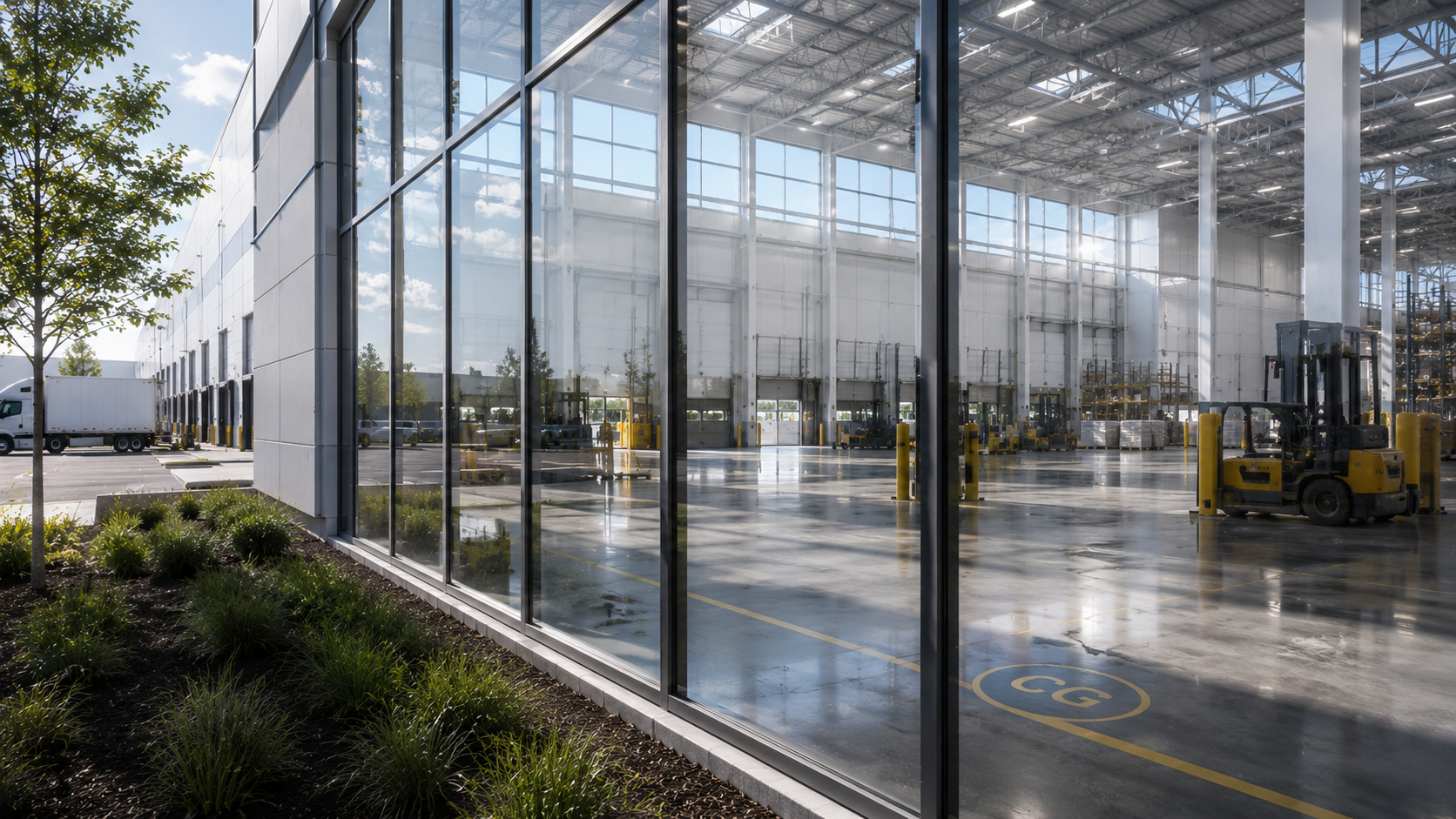
Lobby Modernization
The modern office lobby is being redesigned from a strict security checkpoint into an open, hospitality-focused gateway. Landlords are pushing security perimeters deeper into the building core to create active, light-filled ground-floor environments.
[Traditional Lobby]  --> Hard security at entry -> Heavy framing panels -> Isolation
[Modernized Lobby]    --> Deep security line    -> Structural glass fins  -> Open Sightlines
Structural Glass Fin Walls: Face-lifts for existing lobbies frequently involve stripping away heavy aluminum mullions and replacing them with point-supported, low-iron structural glass fin walls. This creates a seamless, ultra-clear transition from the streetscape into the interior.
Daylight Optimization: Oversized revolving doors, grand glass vestibules, and expansive glass canopies are being used to maximize natural light, supporting interior installations such as coffee bars, collaborative seating zones, and indoor greenery.
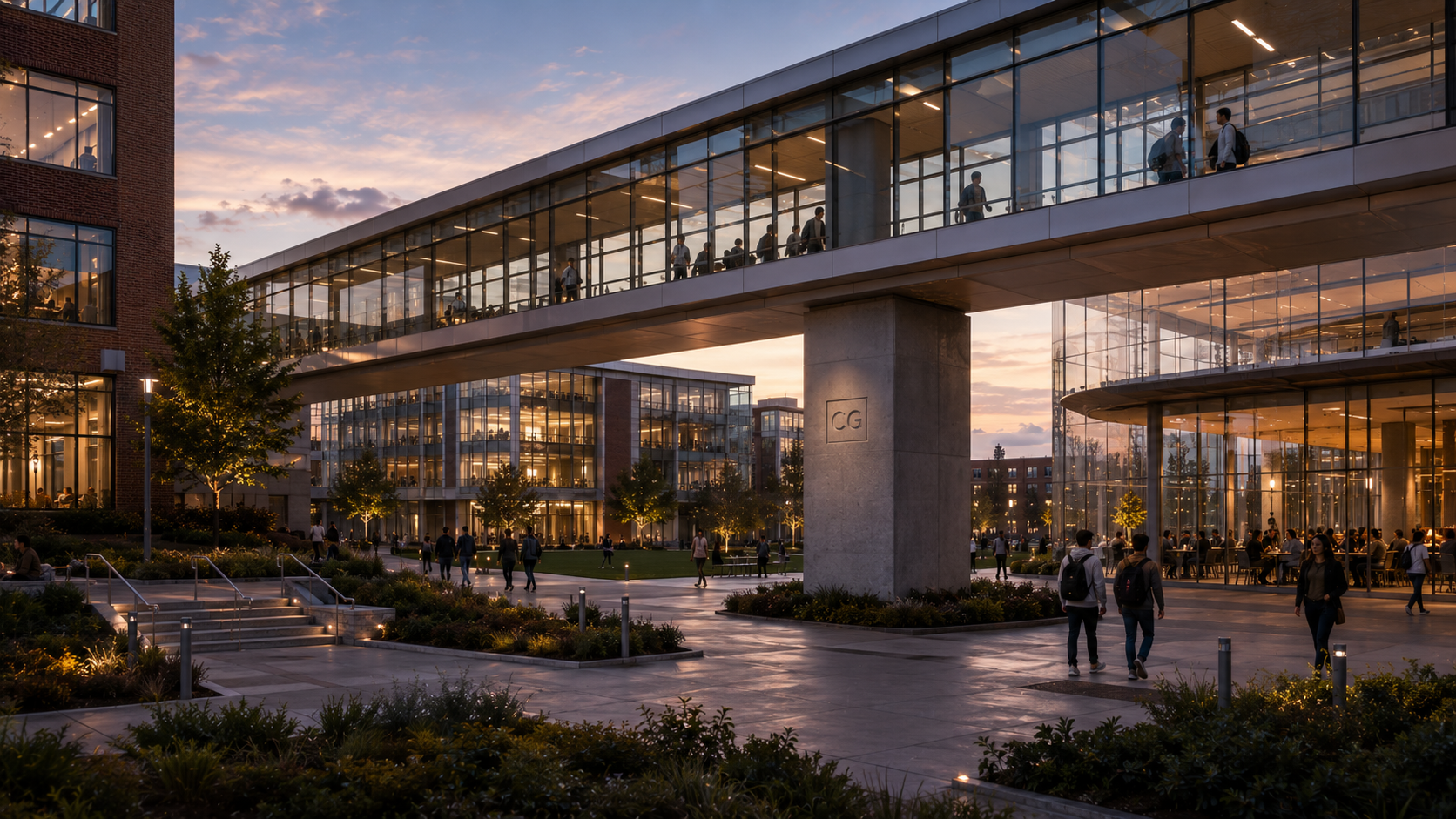
Curtain Wall Upgrades
With new high-rise developments temporarily paused, property owners are protecting the asset value of existing towers by modernizing their building envelopes to meet modern performance standards.
Title 24 Energy Compliance: Driven by California’s stringent Title 24 energy mandates, older Class A curtain walls are undergoing systematic glass replacement. Glaziers are swapping out dated, inefficient insulated glass units (IGUs) for high-performance double- or triple-glazed units featuring advanced low-emissivity (Low-E) coatings.
Thermal Remediation: These structural upgrades involve repairing or replacing aging gaskets, addressing moisture infiltration, and integrating advanced thermal breaks into existing aluminum framing systems. This reduces structural HVAC load and aligns the asset with the strict net-zero carbon goals mandated by institutional corporate tenants.
Glazing Industry Impact: The San Francisco market has transitioned from a high-volume new construction model to a specialized, high-margin retrofit market. Success for commercial glazing contractors relies on technical expertise in structural glass modifications, energy-efficient retrofits, and high-end interior finishes.

Healthcare
Hospitals, medical office buildings, and healthcare campuses continue serving the region.
Patient experience matters.
Accessibility remains important.
Modernization projects frequently support long-term healthcare objectives.
Union Square, neighborhood commercial districts, and mixed-use developments depend heavily on visibility and customer engagement.
Storefront systems help businesses connect with pedestrians while supporting broader property improvement initiatives.
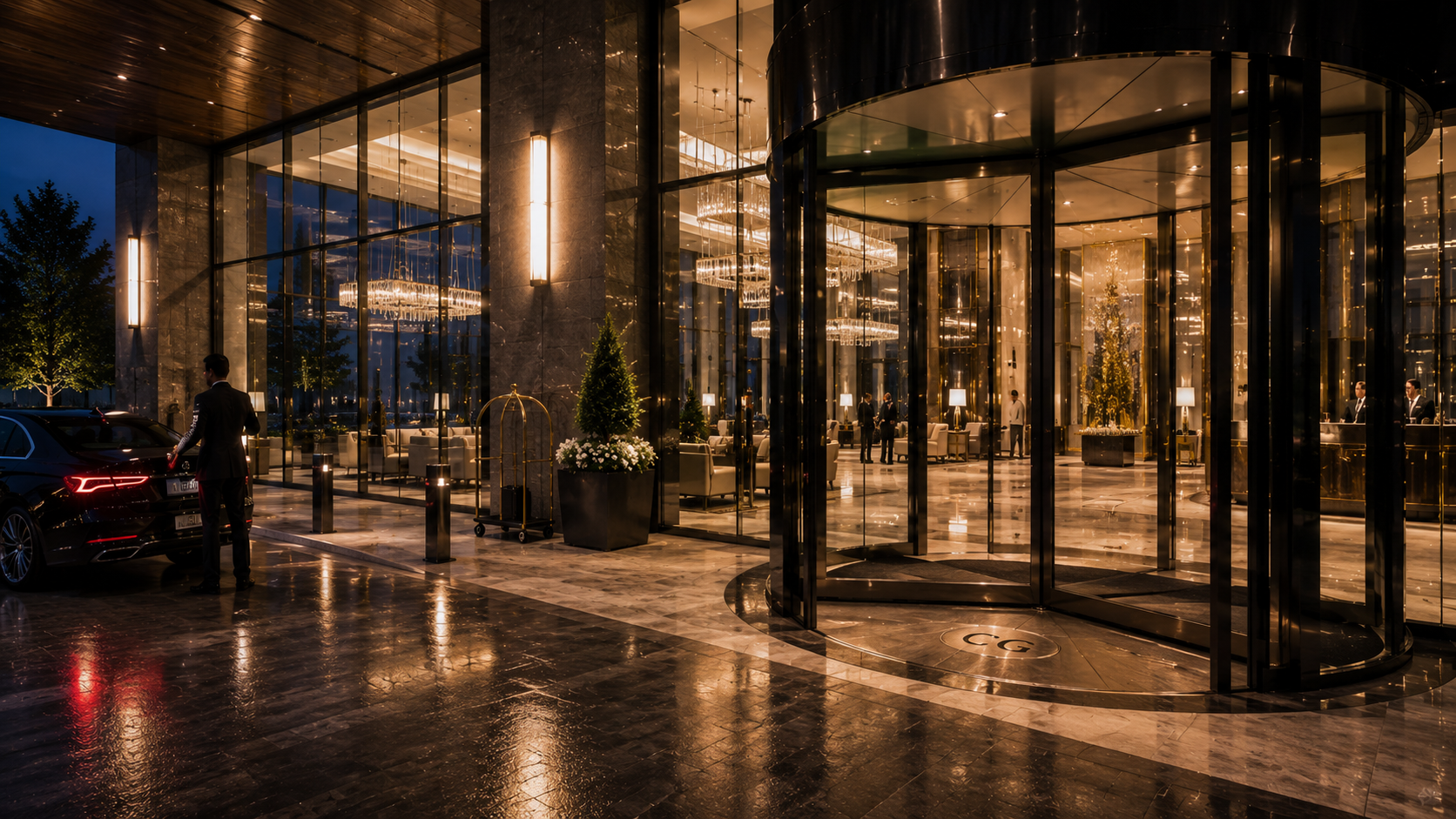
The recovery of San Francisco’s commercial real estate market is highly localized, driven by distinct industry sectors establishing roots in specific neighborhoods. For commercial glazing contractors, each district presents unique project types, architectural demands, and specialized glass performance specifications.
Financial District (FiDi)
As the traditional core of San Francisco’s office inventory, the Financial District is the primary battleground for the flight to quality. While older structures face high vacancy rates, premium Class A and trophy towers are experiencing strong leasing momentum from established firms and capitalized artificial intelligence companies.
Glazing Scope: High-end lobby modernizations, heavy-duty glass entry systems, structural glass fin walls, and large-scale tenant improvements.
Glass Specifications: Low-iron, ultra-clear, thick glass; laminated acoustic partitions; and high-performance insulated glass unit (IGU) swaps to comply with California Title 24 energy-efficiency updates.
SoMa (South of Market)
SoMa is a sprawling, diverse submarket containing everything from modern glass high-rises to historic brick-and-timber industrial warehouses. It serves as a major hub for tech, software engineering, and digital media firms requiring highly collaborative work environments.
Glazing Scope: Comprehensive interior fit-outs, glass partition walls, and adaptive reuse retrofits.
Glass Specifications: Industrial-framed crittall-style interior glass, acoustic glass for private breakout rooms and production studios, and structural glass replacements within existing steel and concrete envelopes.
Mission Bay
Mission Bay is a master-planned, modern commercial district heavily anchored by the University of California, San Francisco (UCSF) medical campus and corporate life science facilities. Unlike other areas, it features relatively low vacancy due to specialized lab infrastructure.
Glazing Scope: Technical laboratory builds, healthcare facilities, and ground-up research developments.
Glass Specifications: High-performance exterior curtain walls with specialized solar heat gain control, blast-resistant glass, clean-room interior glazing partitions, and smart glass panels that dynamically adjust tint based on sunlight exposure.
Union Square
Union Square is the premier retail and hospitality district of San Francisco. The area is currently undergoing structural stabilization, with an emphasis on ground-floor retail re-tenanting, pop-up space activations, and high-end hotel renovations.
Glazing Scope: Luxury retail storefront replacements, secure display window installations, and hospitality entry overhauls.
Glass Specifications: Heavy-duty laminated security glass, burglar-resistant and impact-rated glazing layers, anti-reflective glass for high-end retail displays, and customized architectural metal framing.
Embarcadero
The Embarcadero corridor spans the eastern waterfront, featuring a mix of historic pier redevelopments, premium low-rise office properties, and high-traffic transit hubs. It attracts creative agencies, professional services, and high-end dining.
Glazing Scope: Exterior storefront remediation, waterfront envelope maintenance, and historic window retrofits.
Glass Specifications: Marine-grade corrosion-resistant anodized aluminum framing, high-wind and impact-resistant glazing, and specialized low-E coatings designed to handle intense glare and moisture conditions.
Dogpatch
Located south of Mission Bay, the Dogpatch is an industrial and maker-focused district experiencing a wave of residential and commercial transformation. It features a high density of life science developments, creative office campuses, and production facilities.
Glazing Scope: Multi-use commercial storefronts, life science lab expansions, and industrial-to-office curtain wall installations.
Glass Specifications: Double-glazed high-efficiency windows, storefront framing featuring high thermal performance, and interior specialty glass systems tailored for flexible, multi-tenant creative spaces.
Market Summary: Commercial glaziers must align their bidding pipelines with these district profiles. FiDi and SoMa offer consistent volume in high-end interior and lobby work, Mission Bay and Dogpatch command specialized life science configurations, while Union Square and the Embarcadero require heavy focus on security, retail, and environmental performance.
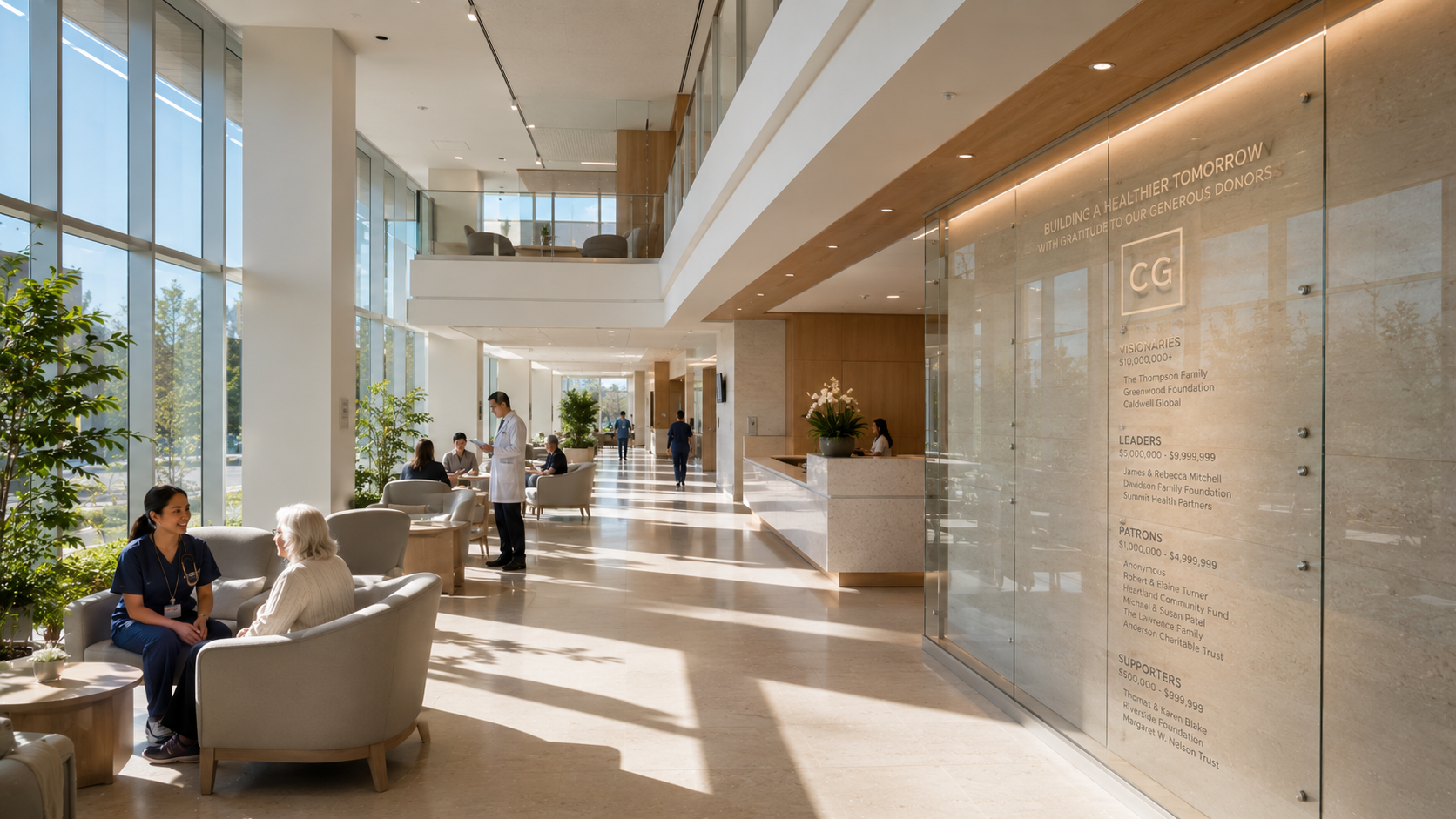
Hospitality
Hotels remain a major component of the city’s economy.
Guest experience influences competitiveness.
Exterior presentation shapes perception.
Storefront systems, architectural glazing, and facade improvements often support hospitality modernization projects.
Higher education institutions contribute significantly to San Francisco’s economy and innovation ecosystem.
Research facilities, academic buildings, student centers, and administrative environments frequently pursue modernization efforts designed to support future growth.